AI
Is AI-Generated Code Production-Ready? Founder's Checklist
By Better Software · Sat Jul 18 2026 · 7 min read
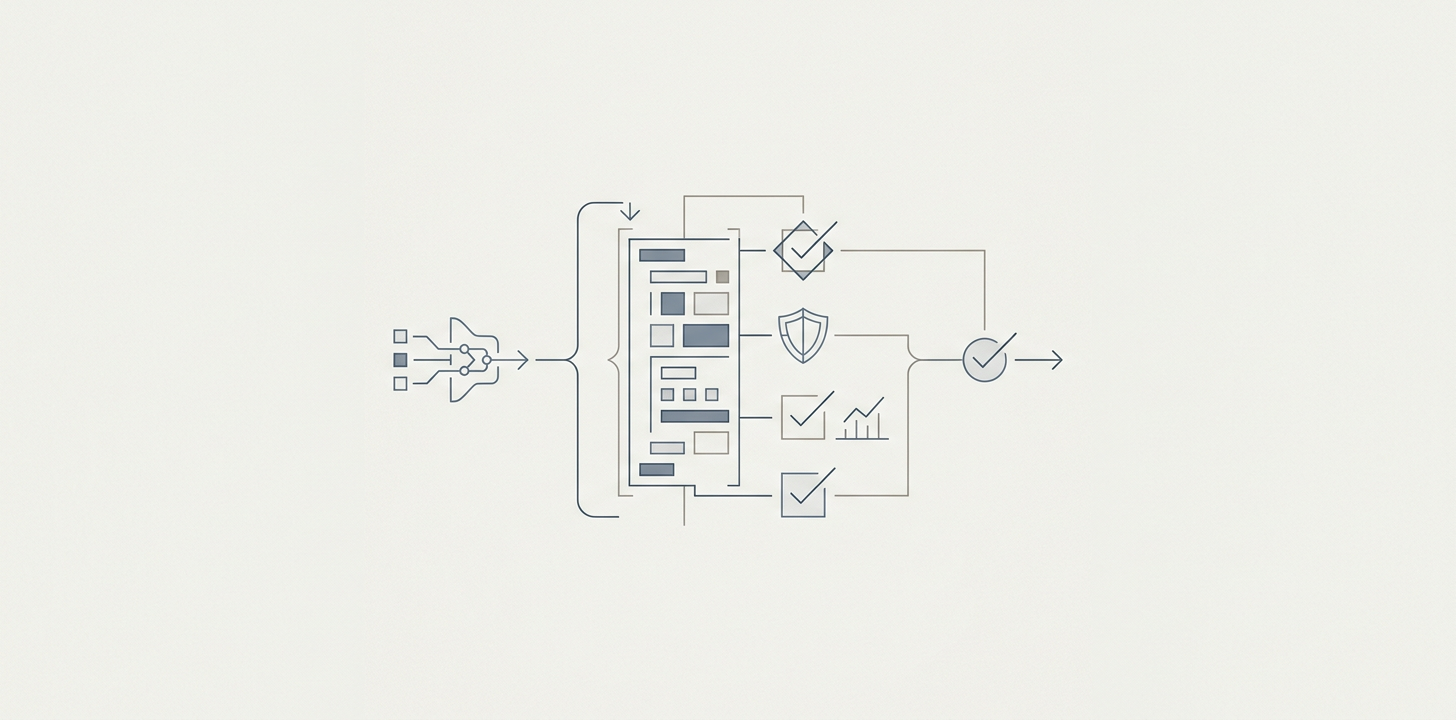
If you built a prototype with Lovable, Cursor, Bolt, Replit, or another AI-first tool, the real question is not whether it works today. The question is whether it can survive contact with users, edge cases, security review, and a real engineering team.
That is what is ai generated code production ready really means in founder terms: not “does the demo run?” but “can we launch this safely, maintain it confidently, and grow it without rewriting everything?”
What “production-ready” actually means for a founder
Production-ready is not a vibe. It is a set of outcomes.
Launchable: it can handle real users without obvious breakage.
Maintainable: a real team can understand, change, and debug it.
Secure: it does not expose data, credentials, or obvious attack paths.
Ownable: your team can take responsibility for it after the prototype phase.
A working AI demo can be impressive and still fail all four. Founders often confuse “the app responds correctly once” with “the system is ready for production.” Those are not the same thing.
A working demo is not a working product
A demo optimizes for proof. A product optimizes for repetition, resilience, and handoff.
AI tools are very good at getting you to a visible result fast: a UI, a workflow, a landing page, a database query, a basic API connection. That is useful. But a demo is usually built with narrow context: a single happy path, lightweight error handling, minimal test coverage, and design decisions made implicitly rather than documented.
A real product needs more than code that runs once. It needs:
- clear data ownership and data model decisions
- predictable architecture boundaries
- test coverage for the paths that matter
- visible security controls
- code that another engineer can safely change
That is the gap most founders hit when they ask whether AI-generated code is production-ready. The answer is: sometimes the demo is launchable, but the codebase is not yet a product.
The three places AI-built products break
1) Context drift
AI is fast, but it is not magically consistent. It can fix one file, one endpoint, or one screen without fully understanding the downstream effect. Over time, the codebase starts to drift: naming conventions change, business logic gets duplicated, and the system’s “truth” lives in multiple places.
For founders, this shows up as strange behavior after small changes. A login flow breaks because of a UI tweak. A pricing rule changes in one place but not another. A feature that looked simple becomes fragile because no one has the full model in view.
2) Tangled architecture
This is the ticking time bomb. AI-generated systems often begin as quick, interwoven solutions: logic in the front end, validation scattered across components, database assumptions baked into prompts, and little separation between product rules and implementation details.
A real team can usually work with a rough prototype. They cannot sustainably work with a system where every change touches five hidden dependencies. If architecture is tangled, speed later gets worse, not better. Every feature becomes risky, and every bug fix creates new ones.
3) Regulated gaps
Some requirements cannot be “prompted into existence.” If you need SOC 2, HIPAA, audit trails, data retention rules, role-based access control, or consent handling, the system needs explicit design decisions and verification. AI can help implement pieces, but it cannot be trusted to infer compliance.
That matters because founders often mistake feature completion for operational readiness. A prototype can look polished while still being unsafe to launch in a regulated environment.
The pre-launch checklist
Use this checklist before you call an AI-built product production-ready. If several items are missing, you likely have a working demo, not a maintainable product.
Security
- Secrets are stored outside the codebase.
- Authentication and authorization are explicit, not assumed.
- Basic input validation is in place on both client and server.
- Error messages do not leak sensitive data.
- You know what data is stored, where it lives, and who can access it.
Data model
- The core entities are named and documented.
- Business rules live in one clear place, not scattered across screens.
- There is a single source of truth for critical records.
- You understand which fields are required, optional, and derived.
- Schema changes are versioned or at least intentionally managed.
Automated tests
- Critical user flows have automated coverage.
- Authentication, payment, data entry, and permissions are tested.
- There are tests for failure states, not just happy paths.
- CI runs the tests automatically before changes merge.
Code review and ownership
- Every change is reviewed by a senior engineer or someone equally accountable.
- No feature ships from raw AI output without human inspection.
- You can explain who owns the codebase after the prototype phase.
- There is a path for refactoring, not just feature addition.
Operational readiness
- Logging and monitoring exist for key flows.
- You can detect failure, not only hear about it from users.
- Backups and recovery are in place where needed.
- Documentation exists for setup, deployment, and key decisions.
If you cannot check most of these boxes, do not ask, “Can we launch?” Ask, “What is the minimum hardening needed before launch?”
You built it with Lovable or Cursor. Now what?
Do not throw away the prototype just because it was AI-assisted. The right move is usually to keep the momentum, then harden feature by feature.
That means:
- freeze the core product shape before adding more features
- map the data model and architecture first
- identify the riskiest flows and stabilize those first
- replace prompt-generated “good enough” logic with explicit implementation where it matters
- add review gates so every change is visible and intentional
This is also where the difference between a demo and an owned product becomes clear. A founder can absolutely use AI to accelerate build-out. But the codebase has to move from “generated” to “governed.”
That is the work Better Software does day to day: build with AI, but coach it with architecture first, data model first, and senior review on every change. The output is not just a fast prototype. It is a system a real team can inherit.
FAQ
Can AI generate production-ready code?
Yes, but only in a narrow sense. AI can generate code that runs, passes a demo, or even supports a limited production use case. What it usually cannot do on its own is make the system maintainable, secure, testable, and easy for a real team to own. The code may be functional; the product may still not be ready.
What is the 30% rule for AI?
There is no universal industry rule, but founders often use “the 30% rule” to mean that AI can accelerate a meaningful slice of the work while humans still own the hard parts: architecture, validation, security, and quality control. The exact percentage is less important than the principle: AI should assist implementation, not replace product judgment.
Is AI writing 90% of code?
Sometimes in specific workflows, AI may generate a large share of the first draft. But lines of code are not the metric that matters. A codebase can be 90% generated and still require extensive human correction, refactoring, and architectural cleanup before it is safe to ship.
Can AI produce code?
Yes. AI can produce code quickly and often impressively. The real question is whether that code fits your product, your risk profile, and your operating model. Production readiness is about the whole system, not just the code snippet.
Is AI code secure?
Not by default. AI-generated code can include insecure patterns, weak validation, missing access controls, and unsafe dependency choices. Security comes from review, testing, and explicit controls — not from the tool itself.
So, is AI-generated code production-ready? Sometimes, but only after it has been turned from a working demo into an owned product. If a real team can understand it, secure it, test it, and extend it without fear, you are on the right side of the line.