Operations
Sold in March, Paid in July: Solar Contract-to-PTO
By Better Software · Sun Sep 13 2026 · 9 min read
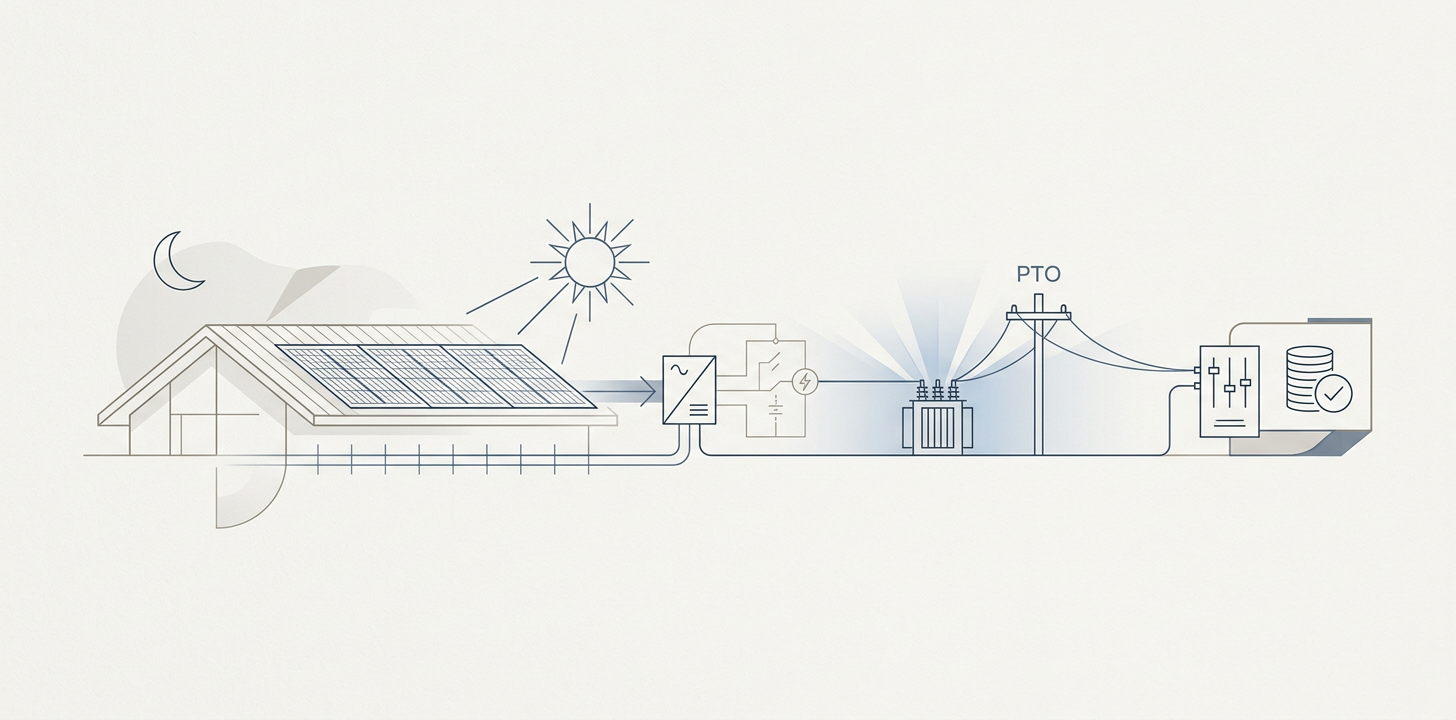
Crew labor and materials are paid before PTO. The customer, lender, or finance partner usually releases the final milestone only after PTO. In between, your business is financing the gap.
The hard part is not “managing projects.” It is knowing where every job is in the queue, how long it has sat there, which delays are yours, and how much working capital each stage is tying up.
| Stage | Typical duration range | Who controls this | What usually makes it longer |
|---|---|---|---|
| Contract signed → site survey | Days to 2+ weeks | You | Scheduling, customer access, incomplete site info |
| Engineering + stamped plan set | Several days to 2+ weeks | You / your engineer | Design revisions, missing equipment specs, load calcs |
| AHJ permit application | Days to weeks | You first, then AHJ | Packet quality, plan review backlog, jurisdiction-specific requirements |
| HOA approval, if applicable | Days to weeks | HOA | Board cadence, aesthetics review, missing forms |
| Permit approval | Days to months | AHJ | Backlog, plan deficiencies, re-submittal cycles |
| Install | 1 day to several days | You | Crew availability, material shortages, weather, change orders |
| Rough / final inspection | Days to weeks | AHJ / inspector | Inspection scheduling, workmanship issues, failed closeout items |
| Utility interconnection application | Days to weeks | You first, then utility | Missing forms, tariff selection, one-line mismatches, utility queue |
| PTO | Days to months | Utility | Utility backlog, missing final docs, meter or service issues |
| Final lender milestone funded | Days to weeks after PTO | Lender / finance partner | Incomplete closeout package, funding review, missing PTO evidence |
The pipeline is a queue, not a project plan
Most solar project management software treats each job like a task list: assign owners, check off subtasks, move the card. That works until the business question becomes: how many jobs are sitting in permit review, how long have they been there, and what is the bottleneck this month?
That is a queue question, not a project-plan question.
A task board can tell you that a job is “in progress.” A queue view tells you whether 40 jobs entered engineering last week and only 12 cleared PTO this week. That difference is everything. Stage entry timestamps matter because they let you measure arrival rate, clearance rate, and age in stage. Without them, a job that is healthy and a job that is stalled can look identical.
Stage by stage, and who controls each one
Engineering and stamped plan set. This is usually still your work. The packet can stall on missing equipment documentation, load calculations, single-line inconsistencies, or a site plan that does not match the roof or meter layout. If the design is wrong, every downstream stage pays for it.
AHJ permit application. Here the ball moves from you to the Authority Having Jurisdiction. Some jurisdictions now support instant-permitting workflows such as SolarAPP+, but only for the installation types and local rules they accept. Where it applies, it can compress review. Where it does not, your packet still enters a conventional plan-review queue.
HOA approval. If the property is governed by an HOA, this is a separate gate. It is not always the longest delay, but it can be entirely outside your control and easy to forget if your software only tracks the build.
Install and crew scheduling. This is yours. The delay drivers are the usual operational ones: labor availability, material readiness, weather, and rework from upstream errors.
Rough and final inspection. The AHJ controls the calendar, but workmanship and closeout quality are yours. Failed inspection usually means more time, more visits, and more cash tied up.
Utility interconnection application and PTO. This is where solar project management software often goes silent. You submit the application, but the utility owns the queue. Missing forms, tariff mismatches, one-line discrepancies, or meter/service issues can push a job back. PTO itself is usually the utility’s decision, not yours.
Final lender milestone funded. The lender or finance partner releases the last payment after PTO and a complete closeout package. If that package is incomplete, the job is effectively done but still unpaid.
The deficiency loop - the one delay that is entirely yours
This is the highest-leverage delay in the business because it is the one you can actually remove.
When a permit or interconnection application comes back deficient, it does not pause and resume where it stopped. It re-enters the queue. That means every rejection is not just a delay; it is a reset.
Common triggers include:
- Missing or mismatched equipment documentation
- Wrong tariff or rate schedule selection
- Single-line diagram and site plan inconsistencies
- Missing signatures, authorizations, or owner affidavits
- Load calculation errors
- Utility-specific form omissions
The measurement most installers do not have is the one they need most: rejection rate by jurisdiction, by preparer/designer, and by deficiency reason, tracked over time.
That gives you three cuts that matter:
- Jurisdiction: which AHJs are costing you the most resubmissions
- Preparer: which designer or packet builder needs coaching or standardization
- Reason: which document type or mistake category repeats most often
If you measure only average days to PTO, you can blame the utility forever. If you measure deficiency loops, you can see what is yours to fix.
What the delay costs, in cash
The working-capital problem is simple to describe and painful to live through: crews and materials are paid before PTO, but the final milestone may not release until PTO.
Use your own numbers:
Cash parked in pipeline stage = jobs in stage × average job cost already spent × percent of that cost not yet recovered
Working capital tied up across all open jobs = sum of cash parked in each stage
Value of reducing a stage by 10 days = daily cash burn in that stage × 10
For a more precise view, track:
- Average contract value
- Percent released at contract, install, inspection, PTO, and funding
- Average direct cost paid before PTO
- Number of jobs currently in each stage
- Average days in each stage
That lets you calculate how much capital is sitting in permit review, inspection queue, interconnection, and PTO hold. A ten-day reduction in just one congested stage can free meaningful cash if that stage contains enough jobs.
What the existing tools do and where they stop
| Tool category | What it genuinely does | What it cannot answer |
|---|---|---|
| Design and proposal tools like Aurora or OpenSolar | Design systems, model production, build proposals, win the contract | Where the job sits after signature, or why it is stuck |
| CRM | Owns the customer record, sales activity, handoff notes | The jurisdiction queue, deficiency history, or PTO status |
| Field service and scheduling | Dispatch crews, manage appointments, coordinate labor | Pipeline age by stage or interconnection delay |
| Construction PM / enterprise PM | Track tasks, dependencies, Gantt charts, larger project portfolios | The solar-specific contract-to-PTO queue without heavy customization |
| Permitting services | Prepare and submit packets | Operational data about rejection rates, queue age, and cash tied up |
| No-code builders | Let you assemble a custom board or ledger | They do not remove the need to own, maintain, and govern it forever |
For a residential or small-commercial operator, most tools cover a slice of the problem. None of them, by default, make the queue visible end to end.
The milestone ledger - the one thing worth building
This is the middle path. Do not rebuild design. Do not replace CRM. Do not try to stand up a full ERP. Build one thin milestone ledger that makes the queue measurable.
At minimum, one record per job should hold:
- Current stage
- Stage entry timestamp
- AHJ
- Utility
- Lender / finance partner
- Funding milestone status
- Every submission and its outcome
- Every deficiency and its reason
That is enough to answer the questions the business actually asks: How many jobs are at each stage? How long have they been there? Which jurisdictions are slow? Which packets come back deficient? Which jobs are parked cash?
This is the kind of record that can sit beside your existing stack instead of replacing it. In our work on solar operating software for Sunny Energy, and adjacent energy information workflows at Nesh, the pattern was the same: the valuable system is not the one that tries to do everything. It is the one that makes the workflow legible enough to operate.
When is it worth building?
- You move enough jobs per month that stage aging matters
- You operate across multiple AHJs or utility territories
- You use more than one finance partner or product
- Your current contract-to-PTO cycle is long enough to pressure cash
- Your existing tools expose APIs or exportable data
When is it not worth it? If you run one jurisdiction, one utility, one lender, and roughly forty jobs a year, a disciplined spreadsheet may be enough. The cost of software is not the question. The cost of owning and maintaining it is.
What to instrument first if you build nothing at all
- Stage entry timestamps for every job, from contract through PTO
- Jurisdiction and utility on every record
- Deficiency reason codes for permit and interconnection rejections
- Days in stage as a weekly report
Those four signals make the queue visible. Once you can see the queue, you can decide whether you need a tool, a workflow change, or a better packet standard.
FAQ
What is solar project management software, and what does it not cover?
It is software for organizing solar work across sales, design, installation, and delivery. In practice, most tools stop at task tracking and handoff management. They do not naturally show stage aging, deficiency loops, or cash parked between contract and PTO.
How long does it take from signed contract to PTO?
There is no honest universal number. It varies by AHJ, utility territory, HOA requirements, inspection availability, packet quality, and financing workflow. The right answer is your own stage-by-stage data, not a market average.
What is PTO in solar?
PTO means permission to operate. It is the utility’s authorization to energize the system and export power, and it is often the event that unlocks the final lender or customer milestone.
Why do permits come back rejected?
Usually because the packet is incomplete, inconsistent, or does not match the local requirement set. Common issues include missing equipment documentation, wrong tariff selection, load calculation errors, and mismatches between the plan set and the application forms.
Should a residential installer use construction project management software like Procore?
Sometimes, but often it is heavier than the problem. Procore and similar tools are strong for construction execution, but they do not automatically solve the solar-specific contract-to-PTO queue. Many installers need a thinner ledger, not a larger platform.
Does instant permitting like SolarAPP+ remove the permitting delay?
It can reduce permit time where the jurisdiction and project type qualify. It does not eliminate AHJ rules, HOA approvals, inspection scheduling, utility interconnection, or the need for accurate packets.
When should an installer build its own project software instead of buying?
Build when the queue is complex enough that your current stack cannot answer stage age, deficiency rates, and parked cash—and when you have the scale and systems maturity to maintain a thin, focused ledger rather than an entire platform.
You cannot shorten the utility’s queue, but you can stop re-entering it. And you cannot manage a queue you have never measured.
For more on how we approach energy workflows, see Energy and the Sunny Energy case study.