Engineering
When to Move from No-Code to Custom Software
By Better Software · · 11 min read
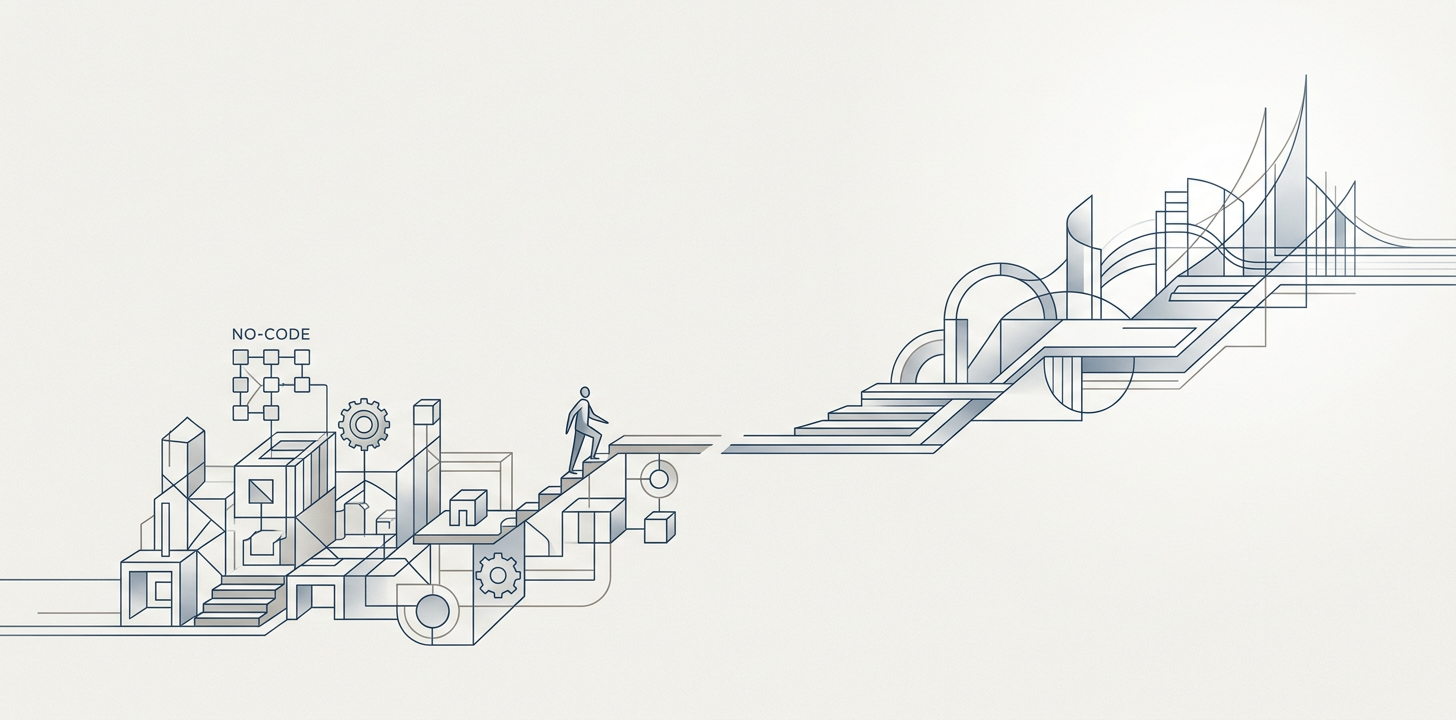
When should you move from no-code to custom software? The short answer
Move when the platform starts making product decisions for you.
Not when you hit a vanity user count. Not when someone says, “we should probably rewrite this.” The right trigger is constraint count: how many times the platform dictates your workflow, your pricing, your security posture, your architecture, or your roadmap.
No-code is often the fastest way to prove demand. The mistake is treating a fast first version as a permanent foundation. Once your business has real revenue, real users, and real operational complexity, the question is no longer whether no-code was “good enough.” The question is whether it is now the bottleneck.
You did not fail at no-code. You outgrew it.
That distinction matters. Bubble, Webflow, Airtable, Zapier, Retool, and modern AI app builders are excellent at getting to signal quickly. They compress the distance between idea and working demo. For many teams, that is the difference between learning and never launching.
But every platform has a ceiling. The ceiling may show up as performance, workflow friction, security review friction, or ownership friction. When it does, the business has not failed. It has entered the next stage.
The best way to think about this is not no-code vs custom development as a philosophical debate. It is a progression. No-code gets you to evidence. Custom software turns that evidence into a system you control.
A thriving no-code app is the best demo there is. It is a working demo of the business that is not yet a working product.
That is the reframe. Your live app is not a throwaway prototype. It is the most valuable specification you will ever have.
The Platform Ceiling Audit: five signals it is time
Use this audit when you suspect outgrowing no code but cannot justify a rewrite. If two or more signals are active, the platform is no longer just a tool. It is now shaping the business.
1. The workaround tax: your team designs around the tool, not the customer
This is the first and often the clearest signal. Your operators know the pattern: an admin process gets split into three steps because the builder cannot handle the ideal workflow; data gets duplicated because the platform cannot model a real relationship; a manual approval step appears because the automation breaks at an edge case.
Healthy friction is normal. Workarounds becoming the system is not.
Look for these thresholds:
- Your team can name more than three recurring workarounds without thinking.
- New features are scoped around platform constraints before user needs.
- Support and operations spend time “teaching the system” instead of serving customers.
At that point, the platform is no longer accelerating product decisions. It is making them for you.
2. Usage pricing is compounding faster than value
One of the most common no code limitations is a cost curve that tracks activity rather than value creation. That is fine at the beginning. It becomes a problem when task usage, workload units, action counts, or add-on fees rise faster than revenue per customer.
The key metric is not absolute cost. It is cost relative to business output. If your automation bill doubles while your conversion rate stays flat, or your Bubble workload units climb with every new customer workflow, the platform is taxing growth rather than enabling it.
Ask three questions:
- Does cost scale with successful usage or with operational inefficiency?
- Can we predict next quarter’s platform bill from current customer behavior?
- Would a growth spurt require us to redesign the product just to afford it?
If the answer is yes, the platform has become a financial constraint, not just a technical one.
3. Performance walls your users can feel
Users do not need to understand why the app is slow. They only need to feel it. Delayed page loads, laggy dashboards, brittle filters, sluggish search, and workflows that time out are not cosmetic issues once the product is in production. They become trust issues.
This is especially visible in bubble app scaling conversations, where apps often work beautifully at early volume and then strain under heavier data, more complex logic, or concurrent usage. The same pattern appears in Airtable-centric operations stacks and AI builders that were never meant to serve as long-term application engines.
Performance becomes a move signal when:
- Users complain before your internal team does.
- Every meaningful feature now requires a performance caveat.
- Improving speed means dismantling the current structure, not optimizing it.
At that point, the product experience is being capped by the foundation.
4. The deals you are losing: security reviews, SOC 2, integrations
This is where many founders first feel the ceiling in revenue terms. A customer wants procurement, SSO, data controls, audit trails, role-based permissions, or a straight answer to where data lives. The platform answer is vague, incomplete, or inadequate.
Enterprise buyers do not care that the app was fast to build. They care whether it can pass a security review. If you are repeatedly losing deals on SOC 2 conversations, access control gaps, integration limits, or ambiguous data ownership, your stack is costing you revenue.
Watch for these signs:
- Sales cycles slow because engineering cannot answer security questions cleanly.
- Each new enterprise prospect requires a custom exception.
- You cannot support the integrations the market now expects.
This is often the point where a no-code business stops looking like a product and starts looking like a risk.
5. Ownership: you cannot take the product and leave
Ownership is the most strategic signal because it governs every future option. If the app, its logic, its data model, or its critical workflow cannot be moved into infrastructure you control, you are renting the core of the business.
This matters when:
- Your roadmap depends on a vendor’s release schedule.
- Exporting data does not mean exporting the system.
- Changing platforms would require rebuilding essential business logic from scratch.
Not every company needs full ownership on day one. But once the business is stable, ownership becomes a competitive asset. It determines whether you can scale, negotiate, secure, and integrate on your own terms.
Why the big-bang rewrite is the wrong instinct
When teams recognize the ceiling, they often swing to the opposite extreme: “Let’s rebuild everything properly.” That instinct is understandable and usually wrong.
Big-bang rewrites fail because they attempt to replace a living business with a theoretical one. The current system is not just code. It is revenue, customer behavior, edge cases, and operational reality. If you freeze the business to rebuild it, you risk creating a perfect system nobody needed in time.
This is where the Better Software view matters: stage-0 thinking starts from the working system you already have. You do not throw away the proof. You use it.
The rule is simple: your live no-code app is the spec. It is the clearest map of what actually matters. Build from the system you have, not from a whiteboard version of the system you wish you had.
Graduate, do not rewrite: the phased migration
The right no code to custom code migration is gradual, not heroic. Keep the business running while you move the foundation underneath it.
Phase 0: Get the data model right first
The data model is the decision everything else inherits. Before you rewrite screens or workflows, define the entities, relationships, permissions, and lifecycle rules that the business truly needs.
This is where most migrations improve by orders of magnitude. The old no-code stack often reveals the real shape of the product through its workarounds. Capture that now.
- What are the core objects?
- What relationships are real versus accidental?
- What permissions need to exist for the next 3 years, not just today?
If you get this wrong, everything downstream gets expensive.
Phase 1: Rebuild the constrained core, keep no-code for the periphery
Do not start with the prettiest screens. Start with the workflows the platform is already failing to support: the slowest, most critical, most revenue-sensitive, or most compliance-sensitive parts of the product.
Leave low-risk admin flows, internal tools, or lightweight content surfaces in no-code if they still serve the business well. The goal is not ideological purity. The goal is removing the constraint.
Phase 2: Move workflows one at a time, with the platform as parity check
Rebuild one workflow, prove it against the live no-code version, then cut traffic over. This makes the migration measurable and limits risk.
Use the old platform as your parity baseline:
- Does the new workflow produce the same outcome?
- Is it faster, safer, cheaper, or easier to maintain?
- Can support still operate without interruption?
The business stays live while the new system proves itself.
Phase 3: Retire the platform, keep the lessons
Once parity is reached, remove the old dependency deliberately. Archive what you need, document the decisions that mattered, and keep the operating lessons. A good migration does not just replace software. It upgrades judgment.
What to require from whoever builds the custom side
If you are graduating from no-code, the next foundation must not become another ceiling. Demand engineering standards that make ownership real.
- Your repo from day one. The code belongs in your control, not hidden behind a vendor or contractor workflow.
- Tests and coverage. Critical workflows should be verifiable, not assumed.
- CI/CD. Releases should be repeatable and low-friction.
- Observability. You need logs, traces, and metrics before the next bottleneck appears.
- Security basics. Access control, secrets management, and auditability should be structural, not bolted on later.
These are not “enterprise nice-to-haves.” They are what keep a custom build from becoming tomorrow’s ceiling.
FAQ
How long does a no-code to custom migration take?
It depends on the size of the core workflow and the amount of operational complexity embedded in the current system. A focused migration can take weeks for the first foundation and then continue in phases over months. The right frame is not “rewrite date,” but “first workflow cutover.”
Do I have to rebuild everything at once?
No. In fact, you should not. Rebuild only the parts that are actively constraining performance, security, scale, or ownership. Keep the rest live until there is a reason to move it.
Can no-code and custom software run together?
Yes, and for many businesses they should. No-code can remain useful for internal tools, peripheral workflows, or lightweight admin surfaces while custom software takes over the constrained core.
What does moving off Bubble or Webflow cost?
The honest answer is: it costs less than a failed rewrite and more than a new plugin. The real cost depends on data complexity, workflow depth, security requirements, and how much of the business logic is trapped in the current platform. The cheapest path is usually phased, because it preserves revenue while reducing risk.
Will no-code replace developers?
No. It changes where developers spend time. No-code is excellent for validation, iteration, and certain internal workflows. Developers become more important, not less, when the business needs durable architecture, deeper control, and systems that can pass enterprise scrutiny.
What is the 80/20 rule in programming?
In practice, it means a small portion of code or functionality often drives most of the value or most of the complexity. In a no-code context, that is useful because it helps you identify the critical core worth rebuilding first.
What is the future of custom software development?
The future is not custom for its own sake. It is custom where the business needs ownership, differentiation, compliance, integration depth, and control. The lowest-leverage parts of software will continue to be abstracted. The strategic core will still need to be built.
Is no-code development a good career?
Yes, especially for operators and builders who understand business workflows. The strongest no-code practitioners are not avoiding software thinking; they are translating it into rapid delivery. The ceiling appears when the problem demands more control than the platform can provide.
When to move from no code to custom software is not a matter of taste. It is a matter of constraint. If the platform is now dictating your product, your economics, your security posture, or your ownership, you have your answer. No-code got you to the business. Custom software is how you keep it yours.