Operations
You Bought Oil and Gas Accounting Software. Now What?
By Better Software · Mon Sep 14 2026 · 11 min read
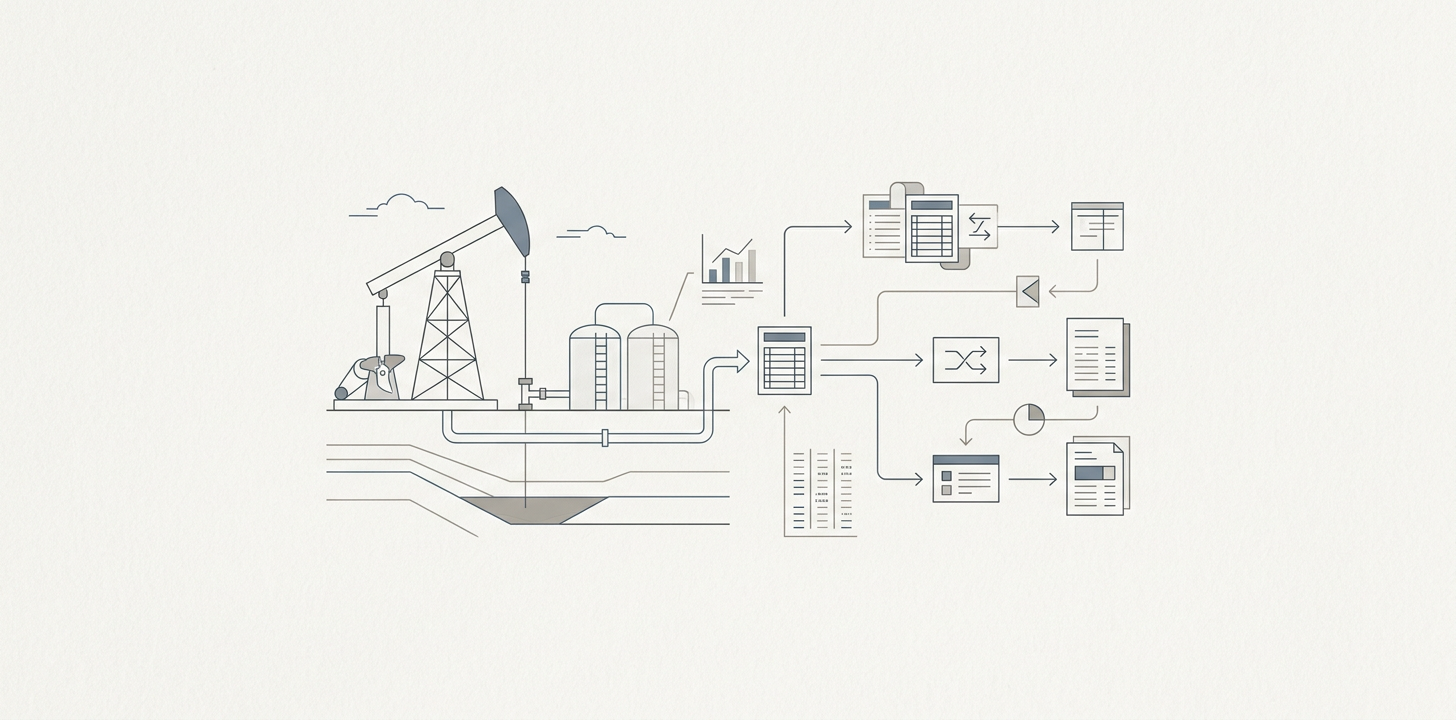
You already bought the accounting system. That part of the job is done. It closes the month, distributes revenue, sends joint interest billings, files severance tax, and produces 1099s. Useful work. Necessary work. But it is not the same as answering the questions an owner asks on Tuesday: which wells are making money, what the current lifting cost looks like by field, whether the interest decks still match the division orders, or whether the JIBs arriving in the mail are correct.
The gap is not another accounting platform. The gap is a reporting layer above the accounting system and the production system, where economics can be joined, queried, and trusted before the next close.
| Layer | What it owns | Cadence | Who uses it | What it cannot answer |
|---|---|---|---|---|
| Field and production capture | Volumes, downtime, run tickets, well-level operational notes | Daily | Pumpers, field supervisors | Margin, owner economics, statutory accounting outputs |
| Accounting | Money, interests, tax treatment, JIB, revenue distribution, AFE, 1099s | Monthly close | Production accountant, bookkeeper | Current well economics, operational decisions, reconciled owner reporting |
| Management and economics | Joined margin, deck integrity, per-well and per-route economics, owner reporting | Continuous | Owner | It usually does not exist as software; it exists as a spreadsheet and one person |
The five jobs your accounting platform should keep doing
Before anything else: do not build the core accounting functions. In upstream oil and gas, the accounting platform is doing hard, necessary, highly specific work.
- Joint interest billing to working-interest partners.
- Revenue distribution to royalty owners and working-interest owners.
- Severance tax by state and by product line.
- 1099 reporting and other statutory outputs.
- AFE tracking and the accounting around approvals, commitments, and actuals.
These are not generic finance workflows. They are contractual, jurisdiction-specific, and better bought than built at the independent-operator tier. The production-first argument is also correct: if your volumes are wrong or late, your accounting outputs will be wrong or late. But that does not make the accounting system the place where management should live. It just means the join has to be accurate.
What the category does, and what it does not
Search results for oil and gas accounting software mostly describe the platform as a feature list: JIB, revenue, royalty distribution, AFE, division order management, severance tax, 1099s. That is accurate, but incomplete. It tells you how the month closes. It does not tell you whether the business made money on a current basis.
That missing layer matters most for established independents: 20 to 800 operated wells, a book of non-operated working interests, a small back office, and a finance team that lives in exports. In that environment, the accounting system is a system of record, not a system of decision.
Interest decks and division orders: where the money quietly goes wrong
Here are the short definitions that matter.
- Working interest: the ownership share that pays a share of costs and receives a share of production or revenue.
- Royalty interest: the share that receives revenue without paying operating costs.
- Overriding royalty interest (ORRI): a royalty carved out of the working interest, usually lasting only as long as the underlying lease or assignment.
- Net revenue interest (NRI): the share of production revenue actually received after burdens such as royalties and ORRIs.
- Division order: the ownership instruction that tells the operator how to distribute revenue for a well or unit.
- Interest deck: the internal ownership map the accounting system uses to calculate distributions.
The problem is not that these exist. The problem is that they drift.
A title update lands. A partial assignment closes. A mineral owner dies and an estate appears. A pooling change or a new unit changes the allocation. Somebody updates the division orders, but the interest deck in the accounting system is still the old version because that is the last file the back office entered. Now the software is not wrong in the abstract; it is wrong relative to current ownership.
That is how the error shows up later: an owner calls, a suspense balance grows, a distribution has to be reissued, or a 1099 no longer matches what the owner expected. The mistake is usually discovered in dollars, months after the change that caused it.
So what does good control look like?
- Keep decks as effective-dated versions, not just current values.
- Reconcile the deck file against the division order file.
- Flag any deck that does not sum to 1.0 by revenue category.
- Keep a change history for every ownership update.
This is not clerical cleanup. It is data integrity for revenue. If the deck and the division order file do not agree, the business does not know who owns what.
A lease operating statement you can read on the 5th
A lease operating statement is supposed to tell an owner what it cost to operate a property and what that property earned. In practice, many lease operating statements are close outputs: accurate enough for accounting, too late for management.
That matters because a current-basis lease operating statement is a different artifact from a month-end close. A management LOS needs to be readable before the close is finished. It needs to combine actuals where they exist with estimates where they do not yet exist. That is acceptable for a workover decision or a route-level cost review. It is not acceptable for statutory billing.
What an owner really needs to see is the cost structure that can still be influenced:
- fuel and power
- field labor
- repairs and maintenance
- water hauling and disposal
- chemicals and consumables
- route-level or pumper-level cost buckets
In upstream operations, the right decision unit is often the pumper route, not the lease. A route shows where the field work actually happens and where costs accumulate together. The accounting system usually reports at the lease or cost-center level because that is how the close is structured. Management needs a different view.
That is why a lease operating statement example from a vendor brochure is rarely useful. The real question is not whether the statement exists. It is whether it can be produced on the 5th with enough confidence to support a workover, a staffing decision, or a capital allocation.
The JIBs arriving in your mail
If you own non-operated working interests, you are on the receiving end of joint interest billings. That asymmetry is one of the most neglected margin opportunities in the category.
What is joint interest billing? It is the process by which one owner or operator bills other interest owners for their share of joint costs under the relevant agreement. In plain English: somebody spent money on a well or a lease, and now you are receiving the bill for your share.
A non-op owner should not read the JIB and hope for the best. The minimum checks are straightforward:
- Is the charge billable under the agreement that governs the property?
- Do the overhead rates match the agreement or accounting procedure?
- Does the billed interest match the owner records?
- Does the charge tie to an approved AFE where one exists?
- Is the timing within the normal billing and audit window?
Today, most of this is checked by eye or not at all. The bill arrives, someone exports it to Excel, and the review becomes a sample-based exercise. That is not a system. That is a hope.
The tooling should look like this: ingest the JIB, normalize the line items, hold the agreement terms as data, and flag exceptions against the rules that matter. Keep a running position by well and by operator. That way the question becomes, “Which bills deserve attention?” rather than “Can someone read this PDF and notice a problem before the deadline?”
This is a margin-recovery exercise. The point is not to invent a savings rate. The point is to make sure you are not paying charges you never had to pay in the first place.
What your partners, bank, and investors are really asking for
Owners do not just need internal economics. They need output for other people.
- Outside working-interest partners want accurate billing, clear support, and a way to see that the operator’s numbers reconcile.
- Reserve-based lenders want timely, consistent reporting that ties production, revenue, and reserves to the collateral story.
- Family or outside investors want a readable operating view, not a dump of accounting exports.
Right now, that reporting is usually hand-built every month. It is assembled from spreadsheets, reconciled by one person who knows where the bodies are buried, and sent out with a prayer that the numbers match the last close. A reporting layer turns that into a published artifact, not a fire drill.
Buy, extend, build: the honest line
Buy the core accounting platform and the production capture app. Do not build JIB, revenue distribution, severance tax, or 1099 reporting. Those are the wrong places to spend engineering capital.
Extend first. Use the exports, scheduled reports, and integrations your current systems already expose. A surprising number of shops should stop there. If you are a small single-state operator, with a handful of wells, no outside partners, and one person who truly has time to own the workbook, an extended reporting stack may be enough.
Build only the third layer: the warehouse and reporting layer that joins production volumes, costs, interests, and prices once; keeps effective-dated decks and reconciles them to division orders; calculates current-basis per-well and per-route margin; audits inbound non-op JIBs; and publishes owner, partner, and lender reporting.
The reason this layer is buildable is simple: it sits above systems of record you keep. It does not carry the regulatory and contractual risk of the accounting core, and it does not need to be migrated every time you change accounting vendors. Build the join, not the ledger.
When should you not build? When the business is too small to benefit from a joined economics layer, when the reporting load is light, or when the team is still improvising around basic data hygiene. In that case, the right answer is to keep the core systems tight and the exports disciplined.
What it looks like when the third layer exists
On Monday morning, the owner opens one view and sees which wells are positive on a current basis, which routes are drifting, which ownership records need reconciliation, and which JIBs deserve follow-up. A question that used to take four days in spreadsheets now takes four minutes. The production accountant is still essential, but they are not trapped as the only person who can interpret the workbook.
That is the point of the layer above accounting software: not to replace the system that closes the month, but to make the business legible between closes. Better’s work in energy information systems has been to join operational data and published outputs into something people can actually use. In upstream oil and gas, that same pattern belongs over the accounting core, not inside it.
FAQ
What is joint interest billing?
Joint interest billing, or JIB, is the process of billing partners their share of costs incurred under a joint ownership arrangement in oil and gas. The operator pays the expenses, then bills the other working-interest owners according to their interests and the governing agreement.
What is an interest deck, and how is it different from a division order?
An interest deck is the operator’s internal ownership file used to calculate revenue distribution. A division order is the external ownership instruction that supports those payments. If the two disagree, distributions can drift from current ownership until someone reconciles them.
What does oil and gas accounting software actually do that QuickBooks cannot?
It handles oil and gas-specific work: JIB, revenue distribution, AFE tracking, severance tax, 1099s, and ownership-based accounting. QuickBooks can record transactions, but it does not understand decks, division orders, royalties, or the statutory and contractual rules that define upstream accounting.
What is a lease operating statement?
A lease operating statement shows revenue and operating costs for a well, lease, field, or route. As a management report, it should be current enough to support decisions. As a close output, it is often too late to help with workovers, staffing, or route-level cost control.
Do I need oil and gas accounting software if I only own non-operated interests?
Usually yes, or at least a system and process to track the JIBs you receive. Non-op owners need a way to audit charges, compare bills to agreements, and maintain a running position by operator and well. If you are receiving multiple JIBs, spreadsheets alone become fragile fast.
Can I audit a JIB I receive as a non-operator, and against what?
Yes. At a minimum, you audit against the governing joint operating agreement, the applicable accounting procedure, your ownership records, and any approved AFE or related authorization. The question is not only whether the bill adds up, but whether the charge is actually chargeable.
What is the best software for the oil and gas industry?
That framing is too broad. For an independent operator, the right answer is usually three layers: production capture, oil and gas accounting software, and a reporting layer above both. Buying the wrong layer is how teams end up with more exports, not better decisions.
Should I build my own oil and gas accounting system?
No. Do not build the accounting core. Buy the platform for JIB, revenue, severance tax, and statutory reporting. If you build anything, build the joined economics and reporting layer above it: the place where production, costs, interests, and prices become usable management information.
The companies that outgrow spreadsheets are not usually missing accounting software. They are missing the layer that makes the month-end close usable before month-end closes.