Operations
Escrow analysis is a data problem with a deadline
By Better Software · Mon Sep 21 2026 · 11 min read
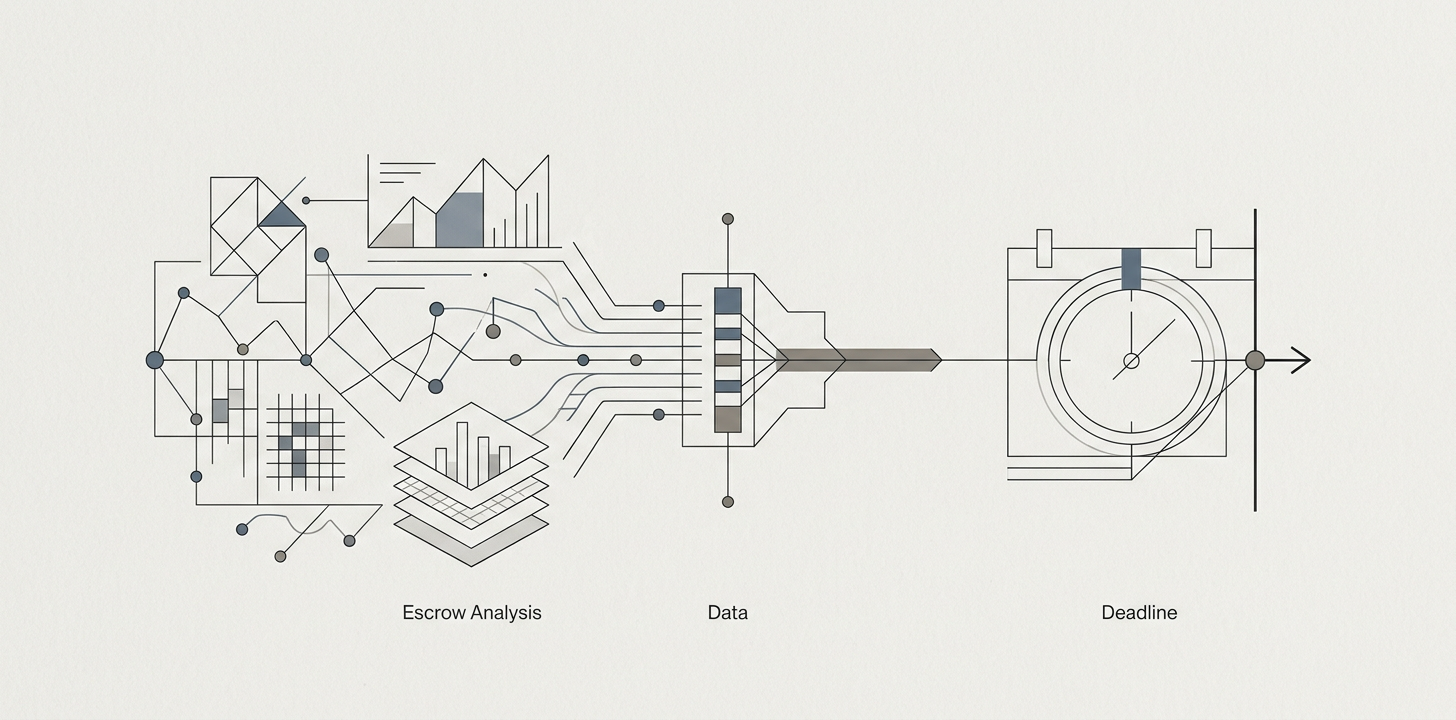
Most homeowners do not search for "escrow analysis software." They search for why their payment changed, why the shortage is wrong, or why the notice does not match the bill they think their servicer should have paid. That is the real signal. When the same questions repeat at scale, the problem is usually not the math in the core servicing platform. It is the data that goes into the math, the exceptions that get handled by hand, and the deadline that turns every defect into a borrower complaint.
For an operator, the useful way to think about annual escrow analysis is simple: the system of record computes from what it is given, but tax data, insurance data, boarding history, suppression rules, and notice timing all arrive from different places. If one of those inputs is wrong, the analysis can be correct as a calculation and still produce the wrong result. The job is to find where that happens before the payment change notices go out.
What the rules require
Regulation X, at 12 CFR 1024.17, is the core rule set for escrow accounts. It requires annual escrow statements, limits the cushion a servicer may collect, and sets the framework for aggregate accounting, shortages, surpluses, and timely notice. Fannie Mae and Freddie Mac add investor guidance on how escrow accounts are administered in servicing. The important point for an operator is that the rules define the outcome, but not how your operation should run internally.
Read the primary rule here: CFPB Regulation X, 12 CFR 1024.17. For investor-side administration guidance, see Fannie Mae servicing guide and Freddie Mac servicing guide.
That distinction matters because many teams try to manage escrow by asking whether the analysis ran. It probably did. The harder question is whether the analysis had the right tax line, the right insurance premium, the right boarding history, and the right suppression status for that loan at that moment.
How the cycle actually runs
In a servicer with any meaningful volume, annual escrow analysis is a sequence, not a single run. A defect introduced in one month often shows up much later as a call spike, a complaint, or an exam question.
1. Upstream data arrives first
Tax services send disbursement amounts, jurisdiction changes, parcel updates, and new bills. Insurance vendors send premium changes, lapse notices, and force-placed coverage events. The boarding team or sub-servicer provides prior escrow history. Those feeds are supposed to land before analysis, but in practice they arrive late, incomplete, or in a format that needs manual cleanup.
2. The servicer applies suppression and exclusion logic
Some loans should not go through a standard annual analysis at all, or should be handled differently because of delinquency, loss mitigation, or bankruptcy status. That logic matters because the notice rules still apply, but not always on the same schedule or in the same way. A bad status flag can make a loan disappear from the queue or generate the wrong notice.
3. The run uses whatever data is available
The core platform calculates projected disbursements, projected balance, shortage or surplus, and the new payment amount. At this stage, the engine is usually not the source of the problem. The problem is that the engine cannot tell whether a higher tax bill is a real reassessment or a mismapped tax line, unless someone upstream has made that distinction visible.
4. Analysts work the exception queue
Manual review is where the operation either recovers or hides defects. Analysts resolve mismatches, override statuses, fix jurisdiction issues, and re-run files. If the queue is not classified by cause, the team may know how many exceptions there were but not why they happened.
5. Statements go out and the phones light up
Payment change notices and escrow statements leave the system. Weeks later, the borrower sees a shortage or a payment jump and calls. By then, the defect may be buried under multiple systems, vendors, and manual fixes. That is why the best diagnostic is not the notice itself. It is the call and complaint volume tied back to the cause of the change.
Where escrow errors actually originate
If you want to reduce complaints, rank the causes by how often they create false or hard-to-explain changes. The list below is the one most operators end up learning the hard way.
- Tax service disbursement amount versus actual bill. The tax vendor file does not match the assessor bill, or the disbursement posted late. The correct response is reconciliation before the run, not after the shortage notice.
- Parcel splits, new construction, and supplemental bills. New parcels and supplemental tax bills often need special handling because the prior escrow history does not map cleanly to the new bill.
- Jurisdiction and millage changes. A tax rate change may be real, but if the tax line setup is wrong, the analysis can overstate or understate the impact.
- Insurance premium changes and force-placed coverage. Premium renewals, cancellations, and lender-placed insurance all affect escrow, but the status change must be reflected accurately in the right cycle.
- Boarded loans with incomplete escrow history. If the prior servicer did not transfer a clean history, the first analysis after boarding is often the riskiest one.
- Mid-cycle status changes. Delinquency, bankruptcy, and loss mitigation can change whether the loan should be analyzed, suppressed, or treated under a different timetable.
A useful diagnostic question for each exception is: did the bill change, did the data change, or did the status change? If you cannot answer that quickly from the file history, the operation is too opaque to explain to a borrower, a client, or an examiner.
Exception categories are better than one big queue
Most teams talk about an exception queue. That is too vague. You need a taxonomy that tells you what kind of problem you have, where it was detected, and what the correct handling should be.
| Category | Correct handling | Common handling | Detection point |
|---|---|---|---|
| After service transfer | Rebuild escrow history, confirm tax and insurance lines, then run the first analysis only after the boarded data is reconciled | Run the cycle with partial history and fix later | Boarding review, pre-cycle control |
| On delinquent loans | Apply the status rule consistently and document suppression or alternate treatment | Let default status bleed into manual overrides | Status file, exception queue |
| Two analyses in one year | Treat mid-cycle re-analysis as an explicit event with a reason code and notice review | Use spreadsheets to explain repeated payment changes after the fact | Cycle management, notice review |
| Schedule by state | Apply state-specific timing and cushion rules, then test notice timing against the actual run calendar | Use a generic national schedule and correct by hand | Rule configuration, pre-run test |
The point of this taxonomy is not paperwork. It is traceability. If you can separate transfer defects from delinquency suppression issues, you can tell whether the fix belongs in boarding, status logic, or notice generation.
What to measure if you want to know whether the operation is healthy
Volume alone is not enough. A servicer can process thousands of analyses and still miss the real problem if it cannot separate genuine escrow increases from data defects.
- Exception rate by cause. The share of files that fail for a specific reason, such as tax mismatch, insurance mismatch, boarding history gap, or status conflict.
- Analyst touches per thousand loans. How many manual actions the team takes to complete the cycle. This shows operational drag better than raw queue size.
- Straight-through rate. The share of loans that run without manual intervention from input load to notice output.
- Payment change distribution. How large the change is across the portfolio, not just the average. A small number of extreme jumps can drive most of the complaints.
- Statements generated late. A timing metric that tells you whether notice deadlines are being put at risk.
- Complaints per thousand statements, split by true increase versus defect. This is the most important number. If you cannot split complaints this way, you do not know whether last cycle’s call spike came from higher taxes and insurance or from bad data.
That split is the whole argument. If a borrower’s payment went up because their county reassessed property value or their insurance premium jumped, the operation still has work to do, but it is a communication problem as much as a servicing one. If the payment went up because the tax line was wrong, that is a defect. Those are different management problems.
What to check before the next run
The best control is pre-cycle reconciliation, not post-cycle explanation. A dry run against last cycle’s data will show problems that a complaint review cannot.
- Reconcile tax vendor bills against tax line setup, including parcel identifiers and jurisdiction codes.
- Check for boarded loans with missing or partial escrow history.
- Review force-placed insurance, renewals, cancellations, and premium changes for the upcoming cycle.
- Validate suppression rules for delinquent, bankrupt, and loss-mitigation loans.
- Sample loans with prior shortages or large payment changes and trace the full path from source file to notice.
- Test state-specific notice timing against the actual production calendar.
If the pre-cycle sample finds the same defect class every time, that is not a sampling problem. It is a process problem. The control is supposed to tell you where the operation leaks before the mail date, not after the branch managers are listening to calls.
Where the core platform stops and the seam begins
Most servicers do not need to build a new calculation engine. They need control over the seam between the core platform, the tax vendor, the insurance vendor, and the people who fix exceptions.
The seam is where three things usually belong:
- Reconciliation between the vendor file and the escrow line.
- An exception workflow with audit trail and reason codes.
- Suppression and review logic that an examiner can follow without reading a spreadsheet held together by comments.
- Reporting that shows the board or operating committee what caused the cycle to move.
That is also the point at which build versus buy becomes a real decision. If you have a small retained portfolio, one tax vendor, one state, and low variation, a separate build may not be worth it. If you have multiple boarding sources, mixed investor rules, state variation, and repeated manual cleanup, the seam becomes operationally material. The question is not whether the core platform can calculate. It is whether your operation can explain the result quickly and repeatably.
Better has built software in mortgage servicing, including work with Valon, and across financial-services operations more broadly, including UTR8 and AllOptions. The pattern is consistent: the system of record computes correctly, while the cost sits in reconciliation, exception handling that has to hold up under review, and reporting that people can produce on demand. See the Valon case study and fintech work for the kind of operational seam that matters here.
Servicing transfer is its own problem
After service transfer, escrow analysis gets harder before it gets easier. The prior servicer’s history may be incomplete, tax and insurance data may not line up with the boarded record, and the first post-transfer analysis often becomes the borrower’s first proof that something is off.
This is why transfer should be treated as a distinct exception class, not just another source of files. The operator should confirm what escrow history arrived, what source documents were retained, whether tax and insurance lines mapped cleanly, and whether the first annual analysis should be delayed until the account is reconciled. If you do not do that, the first shortage notice after boarding can look like a servicing error even when the underlying bill is real.
FAQ
What causes an escrow analysis shortage?
A shortage means the account does not have enough to cover projected disbursements under the current schedule. That can be real, such as a higher tax bill or insurance premium. It can also be caused by bad setup, late vendor data, or a boarded loan whose prior history did not transfer cleanly. The shortage itself is not the diagnosis.
Can you do two escrow analyses in one year?
Yes, but it should be treated as a controlled event with a documented reason. Mid-cycle re-analysis may be appropriate after a tax bill change, insurance change, or transfer correction. The risk is not the second analysis itself. The risk is confusing the borrower with repeated payment changes that are not clearly explained.
What does escrow analysis after service transfer require?
It requires a clean boarding of prior escrow history, confirmed tax and insurance data, and a decision on whether the first analysis can run as scheduled. If the history is incomplete, the safer choice is often to reconcile first and document why the account was held out.
How should escrow analysis on delinquent loans be handled?
That depends on investor and regulatory treatment, but the key operational need is consistent suppression or alternate handling based on the loan status at the time of the cycle. If status changes mid-cycle, the file needs a reason code and an audit trail.
Do escrow analysis schedule rules vary by state?
The federal framework is the same, but state law and investor overlays can affect timing, notices, and account handling. The practical response is to maintain a schedule by state or jurisdiction and test it against the real production calendar, not a generic annual calendar.
If you are running the operation, the next sensible step is not to ask whether your escrow analysis software calculated the right number. It is to ask whether you can trace last cycle’s biggest payment changes back to a real bill, a data defect, or a boarding issue in under a day. If you cannot, that is the seam to fix first.