Operations
What Field Service Software Does Not Tell You About EV Charger Uptime
Quick Answer
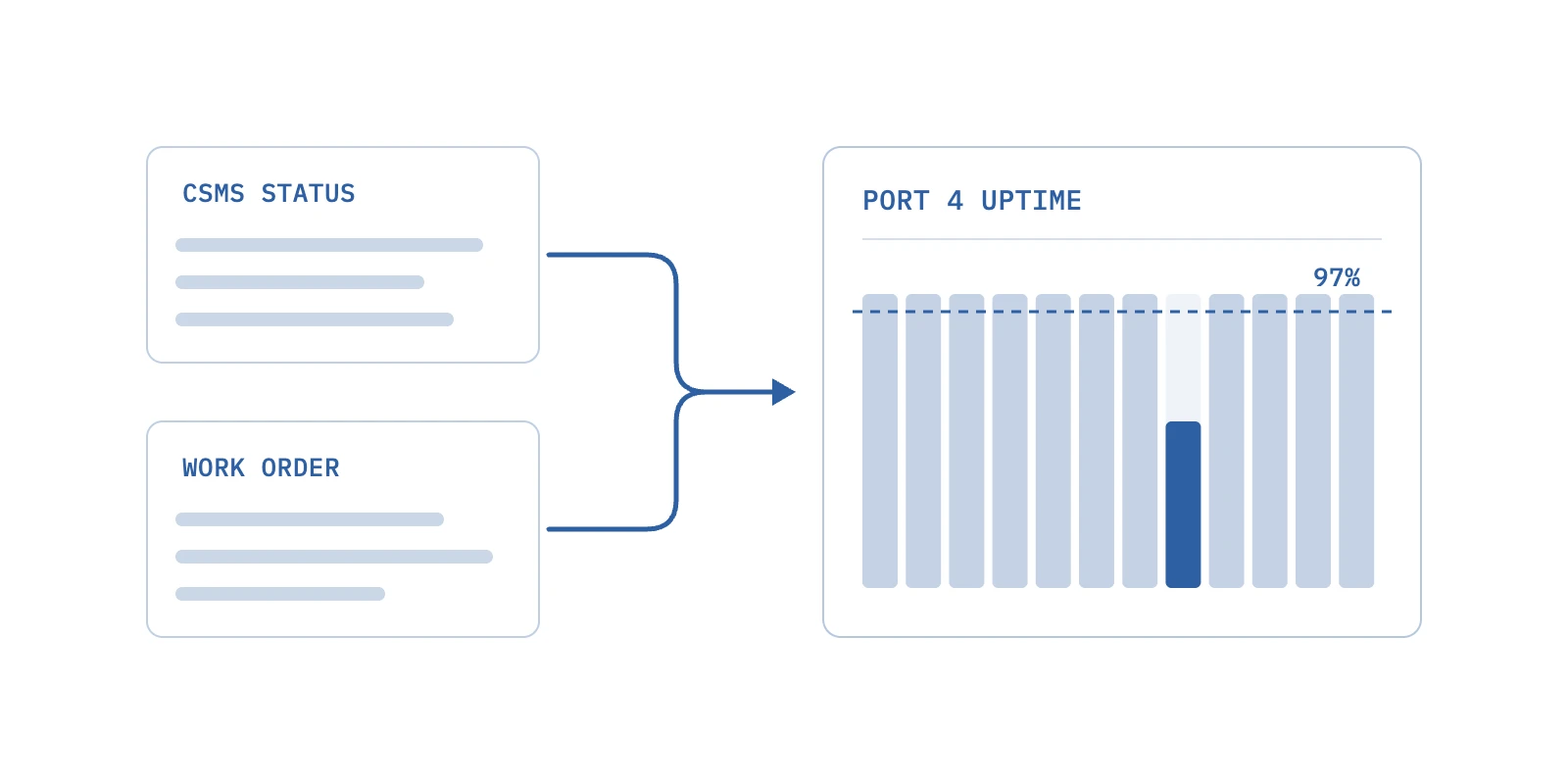
Field service management software records work orders, but charging port uptime depends on status timestamps, outage clocks and exclusion evidence held in several systems. One outage can produce three numbers, because the federal 23 CFR 680.116(b) formula, the California Energy Commission standard and a CEC grant contract cap excluded minutes differently. A per-port outage ledger, evidence for every excluded minute and four weekly numbers make 97% defensible.
Charging port uptime is the share of a year that one connector could actually deliver power, after you remove only the outage minutes the rules let you blame on someone else.
The complaint I keep reading in operator and driver threads is the same. The network dashboard says 98%, the drivers say the fast charger on the end never works, and the grant manager wants a number that will survive an audit.
The problem is rarely the formula. It is that the clock, the repair and the excuse live in three different systems.
In this blog I'll walk through why those systems disagree, how one outage turns into three different numbers, the evidence file behind an excluded minute, the four numbers I would review weekly, and when a custom layer earns its keep.
This is an operations guide, not legal advice.
Why Your Field Service Software and Charging Network Disagree About Charging Port Uptime
They disagree because each system watches a different event. The charging station management system (CSMS) sees status messages, the field service tool sees work orders, and neither one sees the driver who gave up and left. Charging port uptime needs all three.
The gap is not small. When researchers tested all 657 fast-charging connectors at 181 open public stations in the Greater Bay Area, only 72.5% were functional, while the networks running them reported 95 to 98% uptime. I read that study as a measurement problem first, and a hardware problem second.
• The CSMS Sees Status Messages, Not Failed Sessions
Under the Open Charge Point Protocol (OCPP), each port sends an OCPP status notification (the StatusNotification message) whenever its state changes.
Flipturn's guide lists nine OCPP 1.6 statuses, from Available to Faulted, and notes that manufacturers implement them slightly differently. A port can report Available and still fail every handshake, so EV charging uptime built on status alone runs high.
• The Work Order Closes Before the Port Is Proven
A technician closes the work order when the part is swapped. The federal rule only counts a port as up when it successfully dispenses electricity at the required power level. I treat the first successful paid session after the repair as the real end of the outage, not the ticket timestamp.
• Excluded Minutes Need Evidence Nobody Attached
Every rulebook lets you exclude some outages, such as utility interruptions or vandalism. The federal text allows it only where the operator "can demonstrate" the port would otherwise work. That proof is a police report, a utility notice or a maintenance notice, and it usually sits in an email thread, not in either system.
Good tools are getting closer, and charging station uptime reporting is now a standard CSMS feature.
Salesforce Field Service has an AssetDowntimePeriod object with start, end, downtime type and an "Outside Uptime Calculation Period" flag. AMPECO says its CSMS keeps operator-specific uptime formulas for the federal National Electric Vehicle Infrastructure (NEVI) program and for UK and Australian rules, at both charger and connector level. Neither, on its own, joins the status log to the evidence.
One Outage, Three Charging Port Uptime Numbers (Federal, California and Your Grant)
The same outage can count three different ways, because federal rules, California regulation and a California grant contract each start the clock and cap exclusions differently. If you own ports under more than one program, you need to compute charging port uptime once per rulebook, from one shared outage record.
Here are the three rulebooks I read for this post, all checked on October 3, 2026.
| Rule | Federal, 23 CFR 680.116(b) | CEC EV Charger Data and Reliability Standards | CEC grant agreement RNEV-25-004 (Pilot Travel Centers) |
|---|---|---|---|
| Who it covers | Ports built by states or other direct recipients under Part 680 | Publicly or ratepayer funded DC fast chargers installed on or after January 1, 2024, for six years | Four NEVI-compliant DC fast charging ports at one San Diego site, $640,000 grant |
| Threshold | Greater than 97% average annual uptime per port | 97% uptime, calculated per port, not per station | Ports must comply with NEVI Formula Program requirements; uptime reported per port each quarter for five years |
| Period | Previous 12 months, recalculated monthly | Semiannual reports (January to June, July to December) | Calendar quarter |
| Vandalism | Excluded if you can demonstrate it, no cap stated | Up to 10 days per incident | Up to 5 days per event, police report or similar required |
| Scheduled maintenance | Excluded, no cap stated | Up to 72 hours per year | Up to 24 hours per 12 months, scheduled at least two weeks ahead |
| Utility outage | Excluded | Grid power loss excluded | Excluded with documentation from the power provider |
| Communication outage | Not listed | Not listed in the summary I read | Excluded only if chargers default to free charging |
Sources include eCFR 23 CFR 680.116 (eCFR text up to date as of September 30, 2026), the CEC performance standards page, and the CEC November 12, 2025 business meeting packet for the grant terms.
1. Where Each Rulebook Starts the Clock
The federal formula subtracts outage minutes from 525,600 minutes a year. The federal Electric Vehicle Charging Analytics and Reporting Tool (EV-ChART) guide defines an outage as any time a port cannot successfully dispense electricity as expected, measured from the first disruption to the first successful delivery.
The CEC grant goes further.
It takes the longest of three clocks. Those clocks are the status gap from Faulted or Unavailable to Available, the heartbeat gap before a reboot, and the gap from the earliest problem record to the port working again.
That earliest record can be a driver complaint or an inspection, which lives in your ticketing tool, not your CSMS.
2. Which Minutes Each Rulebook Lets You Exclude
All three exclude utility outages, vandalism, natural disasters and scheduled maintenance. The difference is the caps and the paperwork. I keep one record per outage and apply each cap at report time, rather than keeping three versions of the truth.
3. A Worked Example on One Port
Say one fast-charging port had four outages in the last 12 months. This is a hypothetical, and I annualize the grant caps so the three numbers compare like with like.
| Outage | Minutes | Federal excluded | CEC standard excluded | Grant excluded |
|---|---|---|---|---|
| Cable cut, police report filed, 12 days | 17,280 | 17,280 | 14,400 (10-day cap) | 7,200 (5-day cap) |
| Firmware upgrade, scheduled three weeks ahead, 30 hours | 1,800 | 1,800 | 1,800 (under 72 hours) | 1,440 (24-hour cap) |
| Utility outage with utility notice, 9 hours | 540 | 540 | 540 | 540 |
| Power module failure, waiting on parts, 4 days | 5,760 | 0 | 0 | 0 |
| Counted outage minutes | 25,380 total | 5,760 | 8,640 | 16,200 |
| Charging port uptime | 98.90% | 98.36% | 96.92% |
The same port passes two rulebooks and fails the third. Nothing about the hardware changed. Only the caps did.
Pro tip: I compute the strictest rulebook first each month. If a port passes the tightest caps, the other reports are paperwork, not risk.
4. What Changes Before January 31, 2027
The CEC's first semiannual uptime report covers July 1 to December 31, 2026 and is due January 31, 2027. Networked chargers installed on or after September 28, 2026 must report through OCPP 2.0.1 and the hourly data specification.
On the federal side, EV-ChART quarterly data is due by the last day of the month after each quarter, so July to September 2026 data is due October 31, 2026. The CEC also held a public hearing on September 24, 2026 on proposed amendments, so I would recheck the caps before each report.
The Evidence File Behind Every Excluded Minute of Charging Port Uptime
Every excluded minute needs a record that ties the outage clock to its proof. If that record does not exist when the report is due, the minute counts against charging port uptime, so I build the file as outages happen, not at quarter end.
EV-ChART version 6.0, updated October 2025, already shows the shape. Its outage module asks for an outage ID as a UTC timestamp, the duration in minutes, and, as recommended fields, an excluded flag, a reason code from 0 to 6 and a notes field of up to 255 characters.
• Fields EV-ChART Already Asks For
- Outage ID records the start timestamp in RFC 3339 UTC, per port
- Outage duration records minutes from first failure to first successful delivery
- Excluded outage marks true or false
- Excluded outage reason records 1 utility, 2 vehicle fault, 3 scheduled maintenance, 4 vandalism, 5 natural disaster, 6 outside operating hours
- Excluded outage notes hold a short justification
• Attachments the CEC Grant Terms Ask For
- A police report or similar third-party record for vandalism or theft
- Documentation from the power provider for grid power loss
- News reporting plus a narrative for natural disasters
- Proof that maintenance was scheduled at least two weeks before the port went down
• Fields No Regulator Asks for but You Will Want
| Field | Why I keep it |
|---|---|
| Start source | Status message, heartbeat gap, driver complaint or inspection, so the longest clock is provable |
| Work order ID | Links the outage to the field service record and parts cost |
| End proof | Session ID of the first successful charge after repair |
| Visit count | Shows outages that needed a second truck roll |
| Cap applied per rulebook | Shows how many excluded minutes each report actually used |
Pro tip: Ask your field contractor to photograph the damage and the site sign on every vandalism visit. That photo, with the police report number, is what turns a guess into an excluded minute.
Four Charging Port Uptime Numbers to Review Every Week
Four numbers tell you which ports are at risk before the quarter closes. They are unexcluded outage minutes against the yearly budget, open outages with no work order, excluded minutes without evidence, and repeat visits. I pull them every Monday from the outage ledger, not from the dashboard.
1. Unexcluded Outage Minutes Against the Yearly Budget
A 97% threshold allows 15,768 unexcluded outage minutes in a 525,600-minute year, about 10.95 days. For each port, subtract the rolling 12-month counted minutes from 15,768. A port with under two days left needs a spare part on the shelf now.
2. Open Outages With No Work Order
Count ports in a Faulted or Unavailable state, or with a driver complaint, that have no linked work order after four hours. These are the minutes nobody is working on. I expect this is where EV charger reliability slips first, because a CSMS alert often lands in a shared inbox.
3. Excluded Minutes Without Evidence
Sum the minutes flagged as excluded that still have no attachment. Under the grant terms above, those minutes are not excluded yet. I treat this number as a liability on the uptime report, the same way an unreconciled deposit sits on a bank reconciliation.
4. Repeat Visits per Outage
Divide field visits by closed outages for the week. ChargerHelp's 2026 report says 36% of outages need repeat site visits and that those cause 48% of total downtime; that is the vendor's own finding. Watch your own ratio, because a second truck roll usually means the first visit lacked a diagnosis.
Be careful with mean time to repair (MTTR) here. As commonly defined, MTTR does not include waiting for parts or other administrative delay. A service-level agreement that pays on MTTR can look healthy while the port sits down for a week waiting on a power module.
| Number | Source system | Bad reading |
|---|---|---|
| Minutes left in yearly budget | Outage ledger | Under 2,880 minutes (two days) |
| Open outages with no work order | CSMS plus ticketing | Any older than 4 hours |
| Excluded minutes without evidence | Outage ledger | Any at report time |
| Visits per outage | Field service tool | Rising week over week |
Pro tip: I put the yearly budget number next to each port on the dispatch board. Technicians prioritize differently when they can see a port has 900 minutes left.
Where Field Service Management Software Stops, and What to Build on Top
Field service management software is good at dispatch, scheduling, parts and the work order. It stops at charging port uptime because it does not consume the OCPP status stream, does not apply three sets of exclusion caps, and does not know which session proved the repair.
That does not mean you need to build. Here is how I would decide.
| Situation | What I would do |
|---|---|
| Under 20 regulated ports, one CSMS, one rulebook | Export status logs and work orders weekly into one spreadsheet ledger |
| One CSMS that already applies your rulebook | Configure its uptime module and keep the evidence file beside it |
| A field service tool with downtime records, like Salesforce Field Service | Feed it outage starts from the CSMS and track evidence on the downtime record |
| Several CSMS vendors or hardware brands, two or more rulebooks, grant reporting | Build a thin outage ledger that reads from every system and writes each report |
The build case is strongest when you report to more than one program. EV charger maintenance software and CSMS uptime cards each solve their half well. The layer that joins them is usually a few tables and a weekly job, not a new platform, and the systems of record stay where they are.
If the same ports also carry site margin questions, I would put the outage ledger next to the cost data described in how to find true site margin after demand charges.
Solar operators running service fleets face the same split between dispatch and accountability, as I covered in the fleet you already own. The billing side of field work has its own gap, covered in billed, approved, paid.
What does not work is asking technicians to type outage start times into the work order from memory. I would not sign a report built that way, because the start time is the one field the CSMS already knows.
Start With Twelve Months of Status Logs and One Outage Ledger
I think charging port uptime is defensible only when the outage clock, the repair and the evidence sit in one record. Pull twelve months of OCPP status logs, join them to your work orders, and compute every port under each rulebook you report to.
Then attach evidence to every excluded minute and review the four weekly numbers. Field service management software keeps doing dispatch. The ledger is the missing layer, and Better Software builds that kind of layer with operators who already know which ports keep failing.
Frequently Asked Questions
Do EV chargers need maintenance?
Yes. I plan for cable storage, periodic parts checks, cleaning and occasional repairs. The Alternative Fuels Data Center suggests budgeting up to $400 a year per charger, and cites California figures putting DC fast charger extended warranties above $800 per charger per year, which protects charging port uptime after the base warranty ends.
What are some common problems with EV chargers?
In the Bay Area study I trust most, failures came from unresponsive screens, payment failures, charge initiation failures, network failures and broken connectors. The same researchers found cables too short to reach the vehicle inlet on 4.9% of connectors, a site design problem no repair visit fixes.
What does OCPP stand for and what is its purpose?
OCPP stands for Open Charge Point Protocol, which I describe to owners as the open language between a charger and its management system. The Open Charge Alliance lists three versions, 1.6 from 2015, 2.0.1 from 2020, approved as IEC 63584 in 2024, and 2.1 from 2025. Versions 1.6 and 2.0.1 are not compatible.
What's the difference between CRM and FSM?
I think of customer relationship management (CRM) as the system for customer interactions, sales and marketing. Field service management (FSM) covers people and vehicles working at customer sites, including locating vehicles, scheduling, dispatch and links to inventory and billing. Many charging operators run both, plus a CSMS.
What is Mttr and MTBF?
I use mean time between failures (MTBF) as the average elapsed time between failures of a repairable system during normal operation, and mean time to repair as the average time to fix one failure. MTBF tells me how often a port breaks. Repair time tells me how long each break lasts.
About the author

Better Software Team
Product and engineering team
Better Software Team is the product and engineering team at Better Software. We build custom software for established businesses in healthcare, energy and finance.