Operations
What Does Solar Project Management Software Miss About Placed in Service Risk?
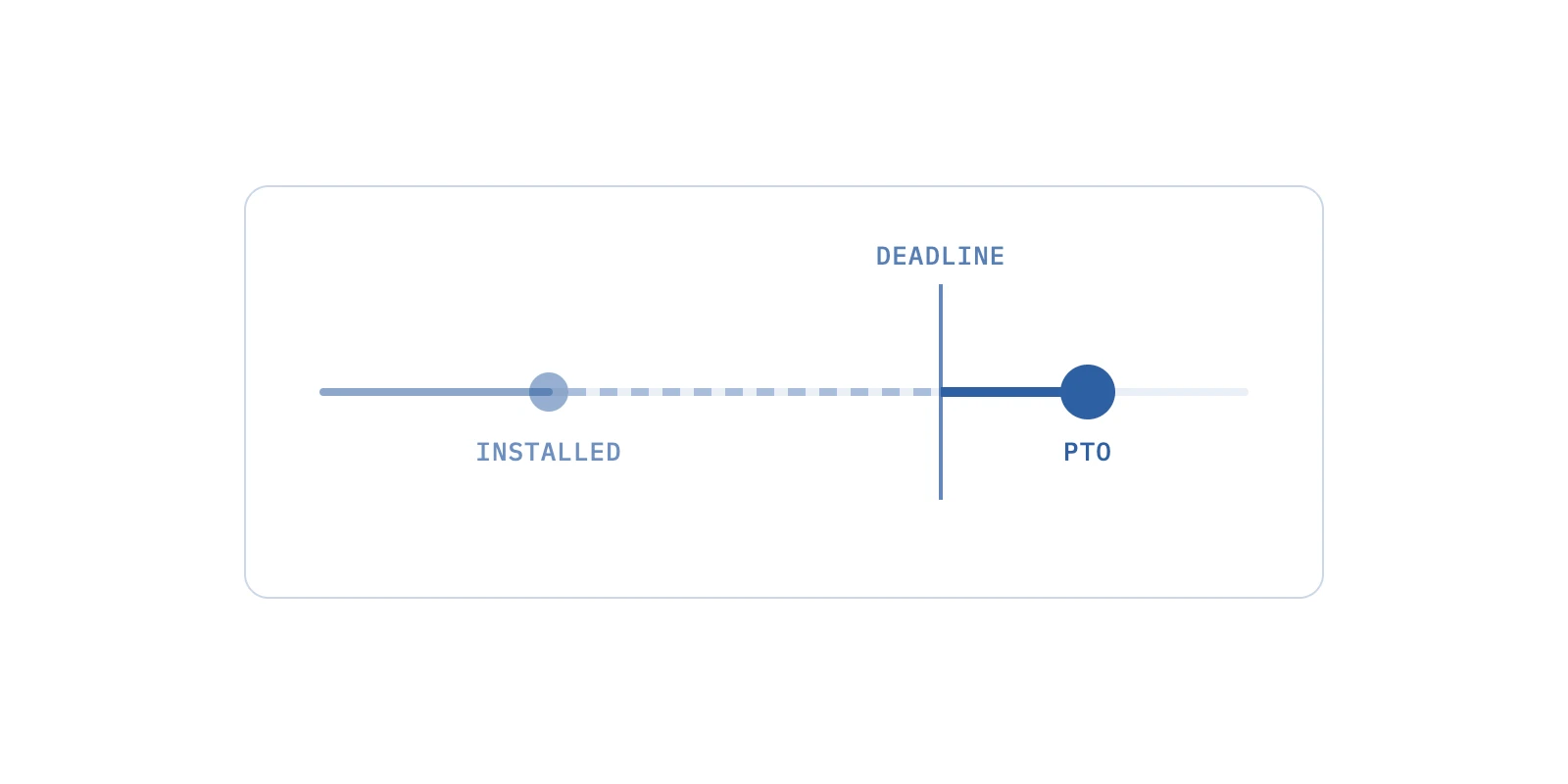
Quick Answer
A grid-tied solar system is usually placed in service when it can deliver power to the grid, which in practice means utility permission to operate (PTO), not install day. Leased and commercial jobs that began construction after July 4, 2026 lose the Section 48E credit unless placed in service by December 31, 2027. Most solar project management software tracks stages, not that date, so installers need per-utility PTO lags, a last safe install date and a weekly at-risk list.
For tax purposes, a solar system is placed in service when it is ready and available to do its job, which for a grid-tied system means producing power the utility has allowed onto its lines. That date now decides if a leased or commercial job keeps its federal credit.
We keep seeing the same gap in installer backlogs. The job board says "installed", the funder says "not yet", and nobody has put a deadline next to either. That deadline is December 31, 2027, for any job that began construction after July 4, 2026.
In this blog we'll walk through which jobs that date applies to, how to turn your own permission-to-operate history into a last safe install date, what your project tools track, and the weekly review we would run until the end of 2027.
This is an operations guide, not legal advice.
How to Tell Which Solar Jobs Will Be Placed in Service Before the Credit Deadline
A job will make the deadline only if its forecast permission to operate (PTO) date, not its install date, lands on or before December 31, 2027 with room for your slowest utility.
We date every open job by the day the utility is expected to let it run, then compare that date with the deadline that applies to the job.
The reason is in the rule text. Treasury's regulation says property is placed in service in the year it is placed in "a condition or state of readiness and availability for a specifically assigned function" (26 CFR 1.46-3(d)(1)(ii)). For a power project, that function is sending electricity to the grid.
Norton Rose Fulbright's Keith Martin put it plainly when summarizing an IRS private letter ruling. A power project is not placed in service until it can send its power to the grid. That ruling let a project count with a temporary route to the grid, which tells you how central grid delivery is.
Here's how we treat each milestone when we plan. Your tax adviser and your funder make the final call on any single job.
| Milestone | What it proves | How we use it for planning |
|---|---|---|
| Contract signed | A customer wants the system | Not evidence of placed in service |
| Permit issued | The local authority approved the design | Not evidence of placed in service |
| Install complete | Hardware is on the roof | Starts the PTO clock, not the placed in service date |
| Inspection passed | The authority having jurisdiction signed off | Often required before the utility grants PTO |
| PTO granted | The utility allows the system to operate | The date we plan the placed in service date against |
| Monitoring online | The system is producing | Supporting evidence, filed with the PTO letter |
The uncomfortable part is that the date you control (install) and the date that counts (PTO) can sit months apart. Every forecast in this post starts from that gap.
Which Jobs in Your Backlog the December 31, 2027 Deadline Applies To
The December 31, 2027 date applies to solar jobs whose construction began after July 4, 2026. The One Big Beautiful Bill Act (Public Law 119-21) ends the 48E tax credit for those jobs if they are placed in service after that date, as the IRS summarizes in Notice 2025-42.
That split matters most to installers selling leases and power purchase agreements (PPAs), where a third-party owner claims the credit. It also covers the commercial solar tax credit on jobs you build for business customers. SEIA notes that third-party-owned systems on homes can still qualify for the Section 48E credit.
On September 25, 2026, Exact Solar, a Pennsylvania and New Jersey installer, described members of its buying co-op who long refused to sell leases or PPAs and now offer them. That shift is why the solar lease tax credit has become an operations problem for installers who never had to track one.
We sort every open job into one of three buckets.
• Jobs That Began Construction Before July 5, 2026
These jobs sit outside the 2027 cutoff if the start is documented. IRS guidance, as summarized in Notice 2025-42, describes a continuity safe harbor. A facility placed in service within four calendar years after the year construction began is treated as continuous.
A job started in May 2026 would have until the end of 2030 under that safe harbor.
• Jobs That Began Construction After July 4, 2026
Every job you sell from here on lands in this bucket. It keeps the credit only if it is placed in service by December 31, 2027. As of today, September 30, 2026, that is 457 days away.
• Jobs Whose Construction Start Is Unclear
This is where we would spend tax adviser time first. The IRS notice that narrowed how construction could start was vacated on June 6, 2026 in Oregon Environmental Council v. IRS, and Crowe expects the government to appeal. Notice 2025-42 listed planning, securing financing and obtaining permits as preliminary activities, not construction.
Pro tip: We record the beginning of construction evidence (date, method, invoices, photos) as fields on the job, not as a PDF in a shared drive. A field can be filtered. A folder cannot.
How to Turn Your Own PTO History Into a Last Safe Install Date
The last safe install date for a utility is December 31, 2027 minus the slow end of that utility's install-to-PTO lag, minus a buffer you choose. You already hold the data to compute it.
We'd bet most installers have never pulled it out of the project tool, because nobody needed a placed in service date by utility until now.
Industry data on solar permission to operate shows why an average is dangerous. In September 2026, Lawrence Berkeley National Laboratory published interconnection timelines for distributed energy projects from 2020 to 2025. Its clock runs from interconnection application to PTO, so it includes construction and inspection time.
| Share of projects by application-to-PTO time, 2020 to 2025 | Under 30 kW | 30 to 100 kW |
|---|---|---|
| 30 days or less | 8.8% | 2.6% |
| 31 to 90 days | 45.8% | 9.9% |
| 91 to 180 days | 27.6% | 16.0% |
| 181 to 365 days | 8.5% | 19.6% |
| 1 to 2 years | 1.1% | 13.1% |
| More than 2 years | 0.1% | 4.0% |
| Still in process | 8.1% | 34.8% |
The spread by state is wider still. Berkeley Lab found that in Massachusetts, 33.0% of systems under 30 kW took 181 to 365 days to reach PTO, and 8.3% took one to two years. In New York, about 90% finished within a year.
Your solar interconnection timeline depends on which utility the roof sits under, so we compute it utility by utility.
1. Pull Install-Complete and PTO Dates for Every Closed Job
Export every job that reached PTO in the last 12 to 18 months with four dates. Pull install complete, inspection passed, PTO application submitted and PTO granted. Drop jobs with a missing date rather than guessing it.
2. Group the Lag by Utility and System Size
Compute install complete to PTO granted, in calendar days, for each job. Group by utility first, then split residential and small commercial, because Berkeley Lab's data shows larger systems wait longer.
3. Use the 90th Percentile, Not the Average
The median tells you what a normal job does. The 90th percentile tells you what one job in ten does, and that job is the one that misses December 31, 2027. We plan against the 90th percentile and watch the median only to spot a utility that is slowing down.
4. Subtract It From December 31, 2027 to Get a Last Safe Install Date
Say you run leased jobs in three utility territories (a hypothetical illustration). Your history shows these install-to-PTO lags, and you add a 14-day buffer.
| Utility (hypothetical) | Median lag | 90th percentile lag | Lag plus 14-day buffer | Last safe install date |
|---|---|---|---|---|
| Utility A | 21 days | 48 days | 62 days | October 30, 2027 |
| Utility B | 40 days | 95 days | 109 days | September 13, 2027 |
| Utility C | 75 days | 160 days | 174 days | July 10, 2027 |
Utility C's deadline arrives almost four months before Utility A's. One company-wide cutoff would either stop selling too early in fast territories or strand jobs in slow ones.
5. Work Back Again to a Last Safe Sale Date
Take your own 90th percentile from signed contract to install complete and subtract it from each last safe install date. With a 75-day sale-to-install time, the hypothetical Utility C's last safe sale date is April 26, 2027. That is the number sales managers need, and it is the one they rarely get.
Pro tip: Recompute the lags every month. When a utility's 90th percentile moves by more than a week, move that territory's last safe install date the same day.
What Solar Project Management Software Tracks and Where It Stops
Solar project management software tracks what stage a job is in and who owns the next step. It does not, out of the box, hold a placed in service deadline per job or forecast one from your utility history.
That is not a knock on the tools. Scoop says it orchestrates permitting, design, procurement, scheduling, installation, PTO and closeout through configurable stage gates. Sitetracker describes milestones tied to billing, interconnection tracking and central document management for developers and engineering, procurement and construction (EPC) firms.
Both describe tracking where a job is. Neither page describes a tax-credit deadline field or a per-utility lag forecast. You can often add one as a custom field, but somebody has to compute the forecast and keep it current.
| Question | What the project tool answers well | What it does not answer by default |
|---|---|---|
| Where is job 1482? | Stage, owner, next task | Its forecast placed in service date |
| Is the utility slow? | Days in the current stage | Your 90th percentile lag by utility |
| Can we still sell this territory? | Pipeline by stage | The last safe sale date |
| What is at risk? | Jobs overdue on a task | Credit dollars that miss December 31, 2027 |
We covered the stage-by-stage pipeline in how solar contract-to-PTO really moves, and permit delays by jurisdiction in which jurisdiction is costing you eleven days. This deadline sits on top of both. It turns a slow utility from an annoyance into a lost credit.
For most installers, the fix is not new solar project management software. It is one more date on every job and one report that reads it.
The Weekly Placed in Service Review We Would Run Through 2027
The weekly placed in service review is a 30-minute meeting on five lists, run every week until the last 2027 job reaches PTO. We would hold it with the operations lead, the interconnection coordinator and whoever talks to your funders.
First, the record. Every open job needs these fields before the review means anything.
| Field | Why it matters |
|---|---|
| Owner of the credit (installer, funder, customer) | Tells you whose credit is at risk |
| Utility and system size (kW AC) | Picks the right lag from your history |
| Beginning of construction date and method | Decides which deadline applies |
| Install complete date | Starts the PTO clock |
| Inspection passed date | Often required before PTO |
| PTO submitted and PTO granted dates | The placed in service date evidence |
| Forecast placed in service date (median and 90th percentile) | The number the review is about |
| Funder milestone deadline | Your funder contract may set its own date |
1. Jobs Past Their Last Safe Install Date
These jobs will likely miss December 31, 2027 even if nothing else goes wrong. Each one needs a decision this week. The options are to expedite, restructure with the funder, or tell the customer. If the funder pays by milestone, the same delay also moves your cash, as we covered in solar milestone payments and the clawback clock.
2. Installed Jobs Waiting on PTO Past the 90th Percentile
A job that has waited longer than nine in ten of its peers often has a problem nobody logged. We would call the utility on each one.
3. Jobs With an Open Utility or Inspection Correction
Every correction resets part of the clock. We list them with the date the correction was sent and the date the utility last replied.
4. Credit Dollars at Risk
Add up the credit on every job whose 90th percentile forecast lands after the deadline. As a hypothetical, 40 leased jobs with a $30,000 credit basis each at 30% put $360,000 of the 48E tax credit at risk. That is the number to bring to your funder.
5. Pipeline Past Its Last Safe Sale Date
Deals still being pitched in a territory past its last safe sale date need different pricing or a different product. Sales should see this list every week.
Pro tip: Ask each funder for its own placed in service and PTO cutoffs in writing. We would store them as a field per funder, because a funder date earlier than the solar tax credit deadline is the one that bites first.
When a Spreadsheet Is Enough and When the Deadline Needs Its Own Layer
A weekly spreadsheet export is enough for a small backlog in one or two utility territories. A read layer on top of your project tool starts to pay once the backlog, the utility count and the funder count grow past what one person can reconcile by hand each week.
We would use three numbers to decide. They are open third-party-owned or commercial jobs, utilities served and funders.
• Stay on a Spreadsheet When the Backlog Is Small
Fewer than about 50 open jobs, one or two utilities and one funder fit in a weekly export. One person can compute the lags monthly and run a weekly at-risk review in an hour. Building anything here would cost more than it saves.
• Add a Read Layer When the Numbers Grow
Past about 200 open jobs, three or more utilities, or two or more funders with different cutoffs, the spreadsheet goes stale between exports. A small layer that reads the project tool and utility portal exports keeps the forecast current without replacing the system your crews already use.
| Signal | Spreadsheet | Read layer on the project tool |
|---|---|---|
| Open jobs needing a placed in service forecast | Under about 50 | Over about 200 |
| Utilities served | One or two | Three or more |
| Funders with different cutoffs | One | Two or more |
| Who updates the lags | One person, monthly | Recomputed on every PTO |
| Main risk | A stale export | Build time before 2027 runs out |
These thresholds are our judgment, not an industry standard. The band between 50 and 200 jobs is a judgment call.
We built sales software for Sunny Energy, a solar installation business, covering proposals, financing, commissions and project management. Our view is simple. Keep the system of record your crews trust and add the missing layer next to it. With 457 days left, the build has to be small.
Put a Placed in Service Forecast on Every Open Job This Week
A job keeps its credit only if it is placed in service on time, and that date belongs to the utility, not to your crew. Pull your install-to-PTO history, compute the 90th percentile lag by utility, and set a last safe install date and a last safe sale date for each territory.
Then run the five-list review every week. We would start with the dates your solar project management software already holds. If a layer that reads them helps, Better Software builds that kind of layer with installers.
Frequently Asked Questions
Is there still a 30% tax credit for solar panels?
For homeowners who buy a system, no. The IRS says the residential credit is not available for property placed in service after December 31, 2025. SEIA notes the Section 48E base credit is 30% for systems under 1 MW, including leased home systems. We would confirm each job with a tax adviser.
How does the IRS verify solar tax credit?
A business claims the energy credit on Form 3468 with its return. A seller using transferability must register with the IRS first and put the registration number on the return. We keep the PTO letter with each job, since it anchors the placed in service date.
What is the 5% safe harbor rule?
It treats construction as begun once at least 5% of total project cost is paid or incurred, followed by continuous efforts, as CLA describes. Notice 2025-42 had kept it only for solar of 1.5 MW AC or less. We would let a tax adviser pick the method before relying on any placed in service extension.
What happens if you turn on solar before permission to operate?
PG&E tells contractors to never turn a system on before receiving PTO and says doing so is against its Electric Rule 21 guidelines. We treat an early switch-on as a compliance problem, never as a head start, and we never date placed in service from it.
Do I get the solar tax credit back in a refund?
Not for homeowners. The IRS says the residential credit is nonrefundable, though unused credit carries forward. Businesses holding a credit for systems placed in service on time can sell it for cash through transferability, and tax-exempt or government entities can use elective pay. We would check eligibility first.
About the author

Better Software Team
Product and engineering team
Better Software Team is the product and engineering team at Better Software. We build custom software for established businesses in healthcare, energy and finance.