Operations
Should You Build Reporting on Your Dental Practice Software or Buy Analytics?
Quick Answer
Most dental groups should buy dental analytics software first. Tools such as Dental Intelligence and Jarvis Analytics read the dental practice management software at each office and already cover production, collections, AR and provider scorecards. A custom reporting layer pays only when questions cross systems those tools do not hold, such as payroll, the general ledger or offices acquired on different software. Hours spent stitching exports each month are the clearest signal.
Business intelligence is how a business turns the records its systems already hold into numbers people trust enough to act on. In a dental group, most of those records sit in each office's practice software.
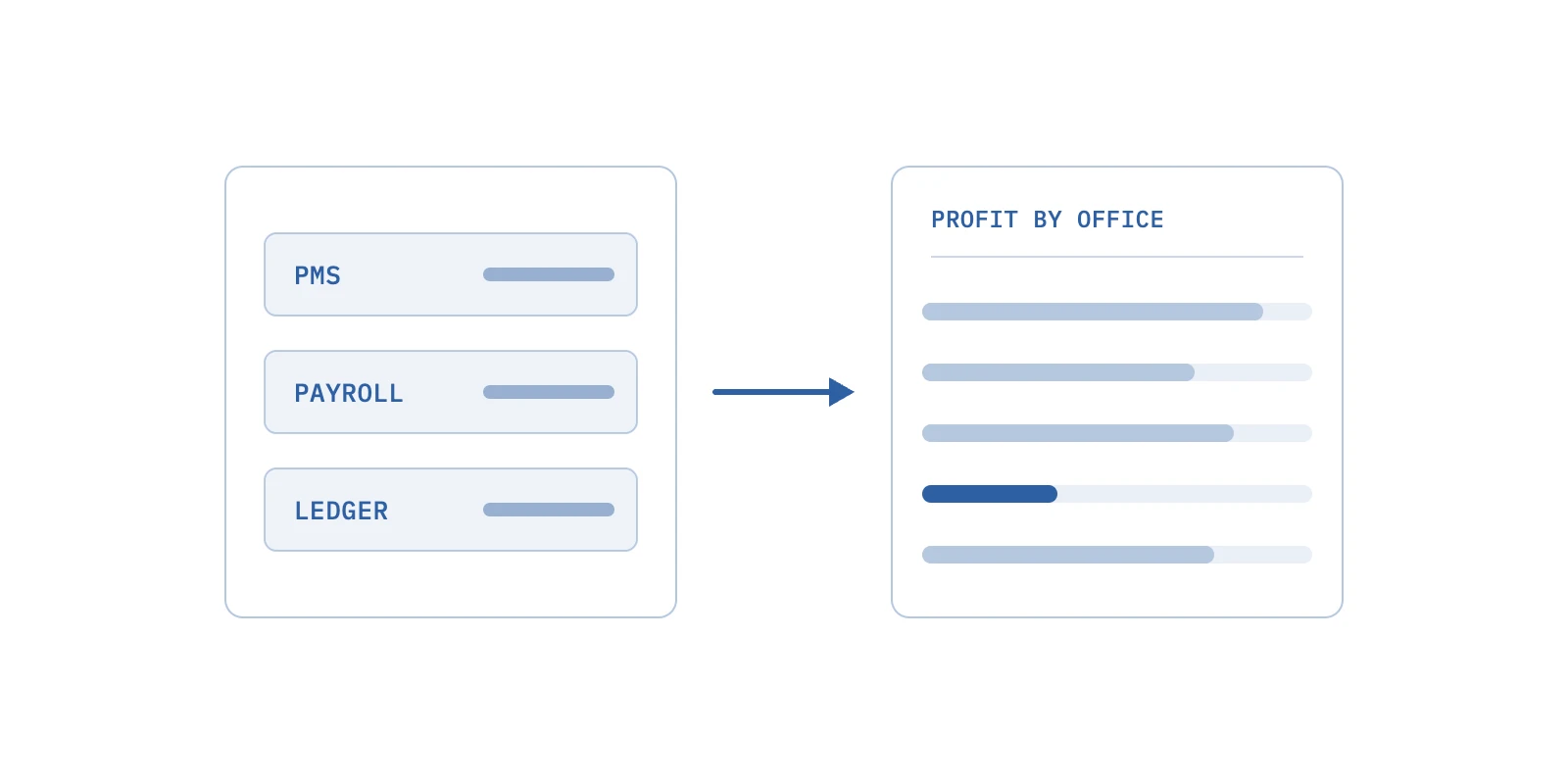
I keep meeting group owners who pay for an analytics subscription and still watch their controller rebuild the board pack in Excel from five exports. The dashboard shows how each office produced. It cannot show which office made money after payroll, because payroll lives in another system.
I'll walk through what analytics tools do well, the four places they stop, my five build questions, and what to build first.
This is an operations guide, not legal advice.
When a Dental Group Should Buy Dental Analytics Software and When It Should Build
Buy dental analytics software when your questions live inside the practice software. Build a reporting layer only when your questions cross into payroll, the general ledger or offices that run different systems.
That is the whole decision in one line. Business intelligence for a dental group is rarely one product; it is usually a bought tool plus a thin layer you own.
When I asked Perplexity on 2 October 2026 how an 18-office group on mixed Dentrix and Open Dental should decide, it said buying was almost certainly the right move. I agree for most groups. Where I part ways is the word "almost", because the exceptions are the groups with the most money at stake.
| Option | What it covers well | Where it stops | Who it fits |
|---|---|---|---|
| Dental analytics software (Dental Intelligence, Jarvis, Practice by Numbers) | Standard dental KPIs, provider scorecards, AR aging, multi-office rollups from the practice software | Payroll, the general ledger, your own metric definitions | Most groups up to the point where finance owns the reporting |
| Generic BI tool on exports (Power BI, Tableau) | Any chart you can design, cheap licenses | Someone has to build and maintain every data feed and definition | Groups with an analyst who already lives in Excel |
| Managed data platform with connectors (CorralData and similar) | Practice software plus finance, HR and marketing connectors, vendor-built dashboards | You rent the data model and its definitions | Groups that want joins without hiring engineers |
| Custom reporting layer | Your definitions, your joins, your access rules | Costs real money to build and needs an owner | Groups whose board questions span several systems |
• Buy When Your Questions Live Inside the Practice Software
If the questions your regional managers ask are about production, collections, hygiene reappointment, case acceptance and AR, a dental analytics tool answers them faster than anything you could build. I would not spend a dollar on custom reporting until this layer is in place and used.
• Add a BI Tool When You Need Different Charts of the Same Data
Power BI Pro costs $14 per user per month, paid yearly when I checked on 2 October 2026. The license is cheap. The person who keeps the data feeds and definitions current is the real cost, and that person is often your controller doing it at night.
• Build a Layer When the Question Crosses Systems
"Which office earned the most after hygienist wages, lab fees and rent?" needs the practice software, payroll and the general ledger in one place.
Of the tools I read on 2 October 2026, only the connector platforms reach payroll and the ledger at all, and they bring their own data model. That is the point where dental business intelligence becomes something you build.
What Dental Analytics Software Already Does Well for a Multi-Office Group
Dental analytics software already gives a multi-office group standard KPIs, location rollups and exports without any engineering on your side. Before anyone talks you into a build, I'd read what dental practice analytics software actually ships, because it is more than most owners use.
| Tool | What its own documentation says it does | Source |
|---|---|---|
| Dental Intelligence | DSO Reports covering Operations, Patients, Procedure Analysis, Revenue Cycle Management, Metric Drilldown and Growth Platform Activity, with an Export Data option and availability in the Analytics-Only portal | Dental Intelligence knowledge base, updated March 9, 2026 |
| Jarvis Analytics (sold by Dentrix as the Profitability Insights Suite) | Near real-time analytics across providers and locations, and Dentrix says more than 3,000 locations trust Jarvis | Dentrix Profitability Insights Suite page |
| Practice by Numbers | Direct practice software integration, production and collections dashboards, AR aging, provider comparison, benchmarking, custom reports | Practice by Numbers feature guide |
| CorralData | Connectors to practice software plus QuickBooks, Sage Intacct, NetSuite, Gusto and ADP, with a dedicated warehouse per customer and row-level security | CorralData dental page |
These are each vendor's own descriptions, checked on 2 October 2026. Pricing is mostly quote-based. The Jarvis pricing page asks you to request a quote, and Practice by Numbers says most platforms run "a few hundred to over a thousand dollars per month", which is its own estimate.
• Standard KPIs Arrive Already Defined
The vendor has already decided what production, collections and case acceptance mean, and you get a ready-made dental KPI dashboard on day one. For a group that has never agreed on definitions, that is a gift. I'd adopt them first and argue later.
• Multi-Office Rollups Work Across Common Practice Software
Practice by Numbers, for example, names Dentrix, Eaglesoft and Open Dental as systems it connects to. A group that bought offices on two systems can still see one rollup, which removes a lot of spreadsheet work for business intelligence at the regional level.
• Exports Cover the Last Mile
When a report runs out, every dental analytics platform above lets you export. That export is also the first sign of the gap. If finance exports the same report every month to join it to something else, you have found your build candidate.
Four Places Dental Analytics Software Stops for a Growing Dental Group
Dental analytics software stops where the data stops, at the edge of the practice software. For a group past roughly ten offices, I see the same four gaps every time, and business intelligence that ignores them produces numbers the CFO will not sign.
1. Payroll and Provider Pay Live in Another System
Hygienist and associate pay sits in ADP, Gusto, Paychex or a spreadsheet. Production sits in the practice software. A cost-per-hour or margin-per-chair number needs both, and a tool that reads only the practice software cannot compute it.
2. The General Ledger Disagrees With the Practice Software
Collections in the practice software rarely equal deposits in the general ledger in the same month. Refunds, chargebacks and payments posted to the wrong office all create gaps. The month-end tie-out is covered step by step in reconciling billing against the books, and it matters even more when the board pack mixes both sources.
3. Acquired Offices Bring Their Own Definitions
A group that buys offices inherits their fee schedules, adjustment codes and habits. One office books a courtesy discount as an adjustment, another as a write-off. The analytics tool will roll both up faithfully, and the rollup will be wrong.
4. Access Has to Follow the Org Chart
Office managers should see their office. Regional directors should see their region. Finance should see everything, including payroll. Many analytics tools handle office and region views. Few carry payroll, so the finance view ends up in a spreadsheet anyway. I'd expect the same pattern inside a dental support organization (DSO) that serves many owners.
My team saw three of these gaps at once while building a custom web application for reporting, payroll, time management and business operations for Apex Dental Partners, a dental group that has grown past 45 practices.
The published lesson from that work is the one I repeat to every owner. A number is only comparable across sites if everyone agrees what it counts, and that agreement is the hard part, not the chart.
The Build Threshold, Five Questions That Decide It for a Dental Group
Build a reporting layer when at least three of these five answers point to build; otherwise keep buying and tighten how you use the tool.
I would print this section for the next leadership meeting, because each question has a number you can find in your own records this week. It is the cheapest business intelligence work you will do all year.
1. Count the Hours Spent Stitching Exports Each Month
Ask your controller and regional managers to log every hour spent exporting, pasting and fixing reports for one full month. Include the board pack, the payroll review and the bonus calculations.
My rule of thumb is simple. Under 20 hours a month, the stitching is annoying but cheap. Over 60 hours a month, or any month where the board pack ships late, the stitching is a hidden salary and a risk.
Pro tip: I ask for the log in 15-minute blocks with the source system named on each line. The list of systems tells you the joins you would need to build.
2. Count the Systems a Board Question Touches
Write down the five questions your board or partners ask most often. Next to each, list every system needed to answer it.
| Board question | Systems needed | Can analytics software answer it alone? |
|---|---|---|
| Production by office and provider this month | Practice software | Yes |
| Collection rate by office | Practice software | Yes |
| Hygiene department margin after wages | Practice software, payroll | No |
| Office profit after rent, lab and supplies | Practice software, general ledger | No |
| Return on an acquired office since closing | Practice software, general ledger, payroll, deal model | No |
If three or more of your top five questions need two or more systems, the analytics tool is answering the wrong layer of questions for your board.
3. Compare Your Definitions With the Vendor's
Pick three metrics your bonuses or partner payouts depend on, such as net production, collections or new patients. Write your group's definition next to the vendor's documented definition.
If your bonus plan pays on a definition the tool does not compute, someone is recalculating it by hand. That person is your single source of truth, and that is a fragile place to keep it.
4. Price the Data Access Before You Price the Build
A build is only as good as its access to the practice software, and access costs differ by vendor. I read these terms before I estimate anything:
- Open Dental says in its integration guidance that customers and third parties do not need Open Dental's approval to read data for dashboards or reporting tools. Writes must go through its API.
- Open Dental read load comes with a warning on the same page. Large or frequent automated read queries can slow the system, so you must be able to switch them off.
- Dentrix lists a one-time $5,000 setup fee for READ access in its Dentrix API Exchange Program FAQ. It also lists a monthly royalty based on the API categories selected. Usage charges apply to read-only use too.
- Dentrix from the cloud needs a local desktop app or service to talk to the Dentrix API because the API runs locally.
Those terms were current on 2 October 2026. A group that runs mostly Open Dental has a far cheaper path to a data warehouse than a group running mostly on-premise Dentrix.
5. Decide Who Owns the Numbers After Launch
A reporting layer needs an owner. That person adds the next acquired office, updates a definition when the bonus plan changes and answers "why does this number look wrong?"
If nobody in finance or operations will own that, do not build. Buy, and accept the limits.
Here is a hypothetical to make the threshold concrete. Say you run a 22-office group on Dentrix and Open Dental, and your controller logs 70 hours a month stitching exports.
Four of your five board questions need payroll or the ledger, and associate bonuses pay on collections net of lab fees. That is four of five answers pointing to build. A group with 25 hours of stitching and questions inside the practice software scores one of five and should keep buying.
How to Measure If Your Business Intelligence Is Paying Off
Measure business intelligence by how fast the month closes into a trusted report, how many hours of manual stitching remain and how often people argue about a number. Good dental practice analytics show up in those three numbers, not in dashboards viewed. I track them before and after any change.
| Number | How to compute it from your own records | What good looks like |
|---|---|---|
| Close-to-report days | Calendar days from month end to the board pack going out | Falling every quarter |
| Stitching hours | Hours logged on exports and spreadsheet fixes per month | Trending toward zero for recurring reports |
| Number disputes | Times a manager challenges a figure in a meeting and it needs research | Rare, and each one ends in a written definition |
• Close-to-Report Days
This is the cleanest test of the whole stack. If the analytics tool is in place and the board pack still takes two weeks, the delay is in the joins, not the dashboard.
• Stitching Hours
Use the same log from the build threshold. A bought tool should cut these hours for practice software reports. A build should cut them for the cross-system reports.
• Number Disputes
Every dispute is a missing definition. I keep a short metric dictionary and add a line each time one gets settled. After a few months, the disputes mostly stop.
Pro tip: Run the five build questions again after every acquisition. A new office on a third practice system can move a group from buy to build in one closing.
What to Build First on Top of Your Dental Practice Management Software
Build the smallest layer that answers your cross-system board questions, and keep your dental practice management software as the record of care. The order below is the one I would follow for business intelligence, because each step pays off on its own even if you stop there.
1. A Metric Dictionary Everyone Signs
Write down every KPI on the board pack with its exact formula, its source system and its owner. This costs nothing but meetings, and it is the step most groups skip. I'd finish it before any code exists.
2. A Nightly Copy of Each Office's Data in One Data Warehouse
Pull each office's practice software data, payroll export and general ledger detail into one dental data warehouse every night through a documented ETL job, the nightly routine that extracts each source, cleans it and loads it. I keep it read only.
Nothing writes back to the practice software, which keeps the record of care safe and keeps the build small.
3. One Location Profit View
Join production and collections to payroll and general ledger costs by office. This is the report your analytics tool cannot produce, and it is usually the one that justifies the whole build. I'd keep the existing analytics subscription running for everything else.
4. Access by Office, Region and Finance Role
Set access rules from the start across office, region and finance roles. Retrofitting permissions after twenty more acquisitions is far harder than building them in week one.
Every layer I'd recommend on top of dental practice management software follows the same rule. Keep the system that runs the chair, and add what the group is missing.
For related reading, see how to score a single report in an unscheduled treatment list for multi-office groups and how a membership plan ledger drifts across locations. The wider test is in buy the commodity, build the moat.
Buy the Dashboard First, Then Build Only the Joins It Cannot Make
I'd start every dental group on bought dental analytics software and keep it running. Then I'd log one month of export hours, list the board questions and count the systems each one touches before spending on business intelligence.
If three of the five threshold answers point to build, add a thin layer over your dental practice management software that joins payroll and the general ledger by office. Better Software builds that kind of reporting layer with group owners who already know exactly which number they cannot see.
Frequently Asked Questions
What is the most commonly used dental software?
I could not find a neutral census of practice software market share. Henry Schein One, which makes Dentrix, says 100,000 practice locations worldwide trust its dental practice management software, a vendor claim I checked on 2 October 2026. I'd treat any single answer as marketing until someone publishes counts.
Is Dentrix a practice management system?
Yes. I'd describe Dentrix as Henry Schein One's dental practice management platform for scheduling, imaging, billing and analytics. Its sibling, Dentrix Enterprise, is built for multilocation groups and unifies all sites into one central database, which changes how a group pulls business intelligence from it.
What does DSO mean in dentistry?
DSO means dental support organization. The ADSO describes DSOs as companies that contract with practices for non-clinical business support such as HR, compliance, accounting and marketing. The ADA Health Policy Institute reports 16% of US dentists were DSO-affiliated in 2024, and I expect that share to keep shaping reporting needs.
What is the role of a data warehouse in healthcare?
I see a data warehouse as the place where data from separate systems is copied into one store for reporting and business intelligence. In healthcare, a vendor that maintains that patient data for a practice is a HIPAA business associate, and HHS lets the practice share data only under a business associate agreement.
What is a KPI in dental?
A KPI, or key performance indicator, is a measure used to judge progress toward a defined objective. In a dental practice I'd expect to see production per hour, collection percentage, hygiene reappointment rate and new patients per month, each tracked against a goal, which is how business intelligence turns raw records into decisions.
About the author

Better Software Team
Product and engineering team
Better Software Team is the product and engineering team at Better Software. We build custom software for established businesses in healthcare, energy and finance.