Operations
What Loan Servicing Software Does Not Tell a Construction Lender Each Week
Quick Answer
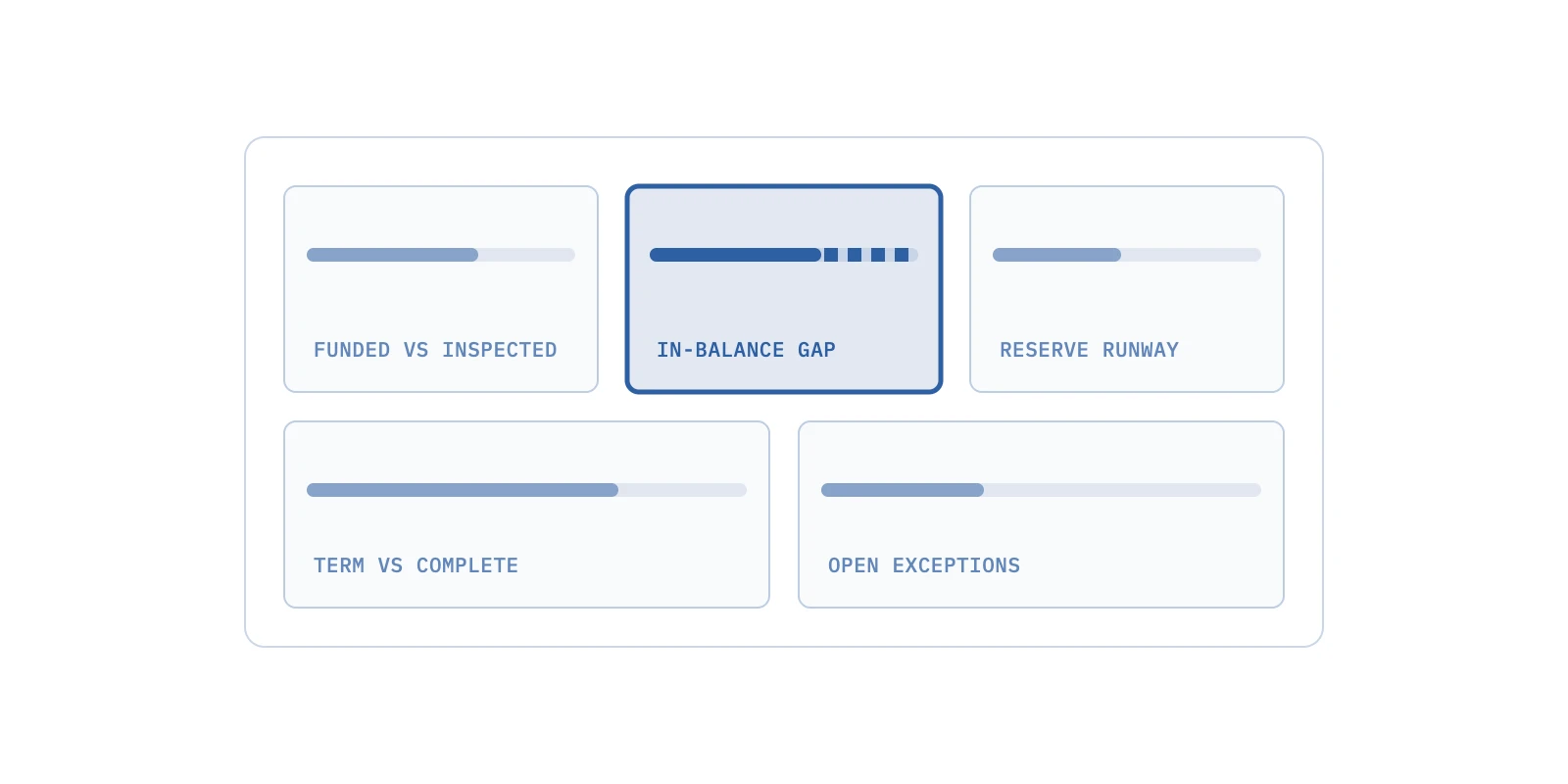
Loan servicing software tracks what a construction loan has funded, what interest has accrued and what remains undisbursed. It does not show if that money will finish the project. A weekly review fills the gap with five numbers per loan, including funded minus inspected percent, in-balance shortfall, interest reserve runway, term used versus work complete, and aged draw exceptions. A spreadsheet works for a small book; a review layer pays off at volume.
A construction loan is a short-term loan that a lender pays out in stages as the building goes up. That makes every draw a fresh credit decision, not a payment.
The pressure on that decision now runs both ways. In a BiggerPockets thread on draw delays, investors said they now vet lenders on draw speed before rate. So lenders are asked to fund faster while the risk sits in data their servicing system never sees.
We will separate the servicing ledger from the draw file and review five weekly numbers. Then we will place draw tools in the workflow and decide when a review layer makes sense.
This is an operations guide, not legal advice.
What Loan Servicing Software Shows on a Construction Loan and What It Leaves Out
Loan servicing software shows the money side of a construction loan, including the commitment, the funded balance, accrued interest, reserves and payment history. It leaves out the evidence that tells you the next advance is safe, which lives with the inspector, the title company and the contractor.
That split follows the construction loan draw process itself. The borrower submits a request, an inspector visits the site, the title company checks for new liens, someone approves, and the wire goes out. Only the last step lands in the ledger.
• What the Servicing Ledger Knows
The ledger knows every dollar advanced, when it went out and what it costs the borrower in interest. If your platform has a budget module, it also knows what is left on each budget line.
We trust that data. It is the system of record, and we would never replace it to fix a draw problem.
• What Lives With the Inspector, the Title Company and the Contractor
The inspector knows how much work is physically in place. The contractor knows what the remaining scope will really cost. The title company knows if a new mechanic's lien was recorded since the last advance.
None of that arrives as clean data. It arrives as PDFs, emails and phone calls.
| Question we ask before funding | Where the answer lives | In the servicing ledger? |
|---|---|---|
| How much has been advanced to date? | Servicing ledger | Yes |
| How much is left undisbursed, by budget line? | Servicing ledger or its draw module | Yes, if budget lines were set up at boarding |
| What share of the work is actually in place? | Inspection report | No |
| What will it cost to finish? | Inspector's review or the contractor's updated budget | No |
| Did prior payments reach subs and suppliers? | Lien waivers and the title update | No |
| Will the interest reserve last until completion? | Reserve balance plus the schedule | Partly (balance only) |
| Will the project finish before maturity? | Inspector's schedule plus loan terms | Partly (maturity date only) |
The OCC's Comptroller's Handbook on Commercial Real Estate Lending (version 2.0, March 2022) expects banks to confirm the budget "remains in balance with sufficient funds available to fund completion." The hardest input to that test, the cost to finish, never sits in the ledger.
Five Numbers We Review on Every Construction Loan Each Week
We review five numbers on every open construction loan, every week, and each one comes from data a lender already collects. Together they sort the book into loans that can fund on the next request and loans that need a call first.
| Number | How we compute it | Inputs | Reading that worries us |
|---|---|---|---|
| 1. Funded minus inspected | Hard-cost percent funded minus inspected percent complete | Ledger, latest inspection | Positive and growing |
| 2. In-balance shortfall | Cost to complete minus (undisbursed funds plus equity on deposit) | Ledger, inspector, contractor | Above zero |
| 3. Reserve runway | Interest reserve balance divided by next month's interest | Ledger, draw forecast | Shorter than months left on the schedule |
| 4. Term used versus work complete | Percent of term elapsed minus inspected percent complete | Loan terms, inspection | Gap widening two weeks running |
| 5. Aged exceptions | Open waivers, title updates, insurance and change orders, with days open | Draw file | Anything open past the next draw |
1. Funded Percent Minus Inspected Percent
Divide hard-cost dollars advanced by the hard-cost budget. Then subtract the percent complete from the latest construction draw inspection. A positive number means money is ahead of the work.
We compare hard costs only. Soft costs, fees and the interest reserve never show up at the site, so mixing them in hides the gap.
The OCC handbook warns examiners about front loading, where a builder "deliberately overstates the cost of the work" in early stages. This number is how front loading shows up in your own data. A few points is normal noise between inspections. A gap that grows draw after draw is a pattern.
2. In-Balance Shortfall
Take the cost to complete construction, then subtract undisbursed loan funds and any borrower equity still on deposit. Above zero, the construction loan is out of balance. Nothing in the ledger flags it, because no budget line is overdrawn yet.
The cost to complete must include everything left, including remaining hard costs, pending change orders, fees and the interest still to accrue. CFSI's fund control guide puts the same concern plainly, saying a project can be "in balance mathematically while still being underfunded economically."
Say you run a $2,000,000 loan. You have advanced $1,300,000, so $700,000 is undisbursed. The inspector's review says finishing will cost $820,000. That is a $120,000 shortfall, and the next draw should wait until the borrower deposits equity or the scope changes.
Pro tip: We ask the inspector for a cost-to-complete figure on every visit, not only percent complete. Percent complete tells you about the past; cost to complete tells you about the next six months.
3. Interest Reserve Runway Against the Schedule
Divide the reserve balance by next month's interest, then compare that to the months left on the inspector's schedule. For an interest reserve construction loan, next month's interest uses the balance after the draws you expect to fund, not today's balance.
In the same example, at 11% on $1,300,000, one month of interest is about $11,917. A $60,000 reserve covers roughly five months. If the schedule shows seven months to completion, the reserve runs out first, and every future draw makes that worse.
The OCC handbook notes that extended lease-up periods "can deplete the interest reserve prematurely." We would rather see that in week one than in the month the reserve hits zero.
4. Term Used Versus Work Complete
Divide the months since closing by the loan term. Compare it with inspected percent complete. Eight months into a twelve-month loan, 67% of the term is gone. If the inspector says 52% complete, maturity will arrive well before the certificate of occupancy.
That gap predicts extension requests. Extensions add interest and fees, which push up the loan-to-value ratio at exactly the wrong time.
For banks, 12 CFR Part 365, Appendix A sets supervisory limits of 80% for commercial and multifamily construction and 85% for one- to four-family residential construction. Private lenders are not bound by those limits, but they are a useful outside benchmark.
5. Open Draw Exceptions and Their Age
List every open item on the loan with the days it has been open, including missing lien waivers, pending title date-downs, expired builder's risk insurance and unapproved change orders. Age matters more than count.
The OCC handbook notes that in some jurisdictions a mechanic's lien can take priority over the bank's lien, so lenders there update the title insurance policy with each draw. We treat any waiver or title item still open when the next request arrives as a hold, not a note.
Track retainage in the same place. Under progress payment plans, the handbook says banks normally hold back 10 to 20 percent of each payment. That retained amount is a real liability you will release at the end, and it belongs in the review.
Where Construction Draw Management Software Fits in the Construction Loan Process
Construction draw management software runs the workflow for each request on a construction loan, including intake, documents, inspection, approval and funding. It is strong on the single draw. The weekly portfolio view depends on data that outside parties still send you as documents.
Here's how the main options compare when we look at them for the weekly review.
| Option | What it does well | Where it stops for the weekly review |
|---|---|---|
| Servicing platform with a draw module | Keeps budgets, draws and the ledger in one system | Cost to complete and title status still arrive from outside |
| Standalone draw management platform | Borrower portal, budget templates, approval routing | A second system to reconcile with the ledger |
| Outsourced fund control service | Independent review and a funding recommendation per draw | You still own the portfolio view and the decision |
| Inspection network | Fast, standardized site reports | Reports progress, not your whole position |
| Spreadsheet | Cheap, flexible, fast to start | Breaks once several people update it |
• Servicing Platforms With a Draw Module
Some loan servicing software now includes draw handling. The Mortgage Office launched its Construction Draw Manager on January 15, 2026, and its construction page lists borrower draw requests, approvals, budget tracking and remaining funds at the project level.
That is a real step forward, and we would configure it before building anything. The remaining-funds figure is still budget math, not the inspector's view of what finishing will cost.
• Standalone Draw Management Platforms
Built's draw management product lists customizable templates, budget and collateral calculations, budget change management and digital draw requests. Built also markets an AI draw agent.
Platforms like this suit lenders with high draw volume. The trade is one more system, which means the draw ledger and the servicing ledger must agree every month.
• Fund Control Services and Inspection Networks
Fund control firms such as CFSI review each draw against budget, inspection, invoices and lien documents, then recommend an amount. Inspection networks such as RAZE standardize the site report and deliver it by API.
Both improve the inputs. Neither owns your portfolio view, and CFSI states plainly that the lender keeps final authority.
How We Would Set Up a Weekly Construction Loan Review With the Data You Already Have
We would build the first version of the weekly review from exports you already have, before buying anything. The goal is one row per construction loan, refreshed every week, with the five numbers and a recorded decision.
1. Export the Servicing Ledger Every Friday
Pull commitment, funded to date by budget line, undisbursed balance, rate, reserve balances, closing date and maturity for every active construction loan. If the budget lines were entered loosely at boarding, fix that first. We wrote about why loan boarding is where the exception queue starts.
2. Attach the Latest Inspection and Cost to Complete
Record the inspection date, inspected percent complete and the cost-to-complete figure. An inspection older than the last draw gets flagged, because the numbers above go stale with it.
3. Log Waiver, Title and Insurance Status Against Each Draw
For every funded draw, record which lien waivers came back, the title update date and the insurance expiry. This is the step most lenders keep in email, and it is where aged exceptions hide.
4. Sort by Shortfall, Then by Runway
Put out-of-balance loans at the top, then loans whose reserve runs out before the schedule ends. Check each loan against the construction loan draw schedule agreed at closing, so you can see which projects have drifted.
5. Record the Decision on the Next Draw Request
When the next construction loan draw request comes in, the reviewer already knows the loan's position. Record the decision as fund, reduce, hold or fund with conditions, with a reason.
The OCC handbook lists dual approval of disbursements and segregation of duties among effective controls, so we keep the approver and the person who wires the funds separate.
The record behind this review needs these fields at minimum.
| Field | Source | Why it matters |
|---|---|---|
| Hard-cost budget and funded to date | Servicing ledger | Number 1 |
| Undisbursed loan funds | Servicing ledger | Number 2 |
| Borrower equity on deposit | Servicing ledger or escrow | Number 2 |
| Cost to complete, including pending change orders | Inspector or contractor | Number 2 |
| Interest reserve balance and rate | Servicing ledger | Number 3 |
| Months left on the schedule | Inspector | Numbers 3 and 4 |
| Closing date, term and maturity | Loan terms | Number 4 |
| Inspected percent complete and inspection date | Inspection report | Numbers 1 and 4 |
| Retainage held | Draw file | Number 5 |
| Open waivers, title and insurance items with dates | Draw file and title company | Number 5 |
Pro tip: Keep the reason for every reduced or held draw in the same row. When a borrower disputes a hold three months later, that note is the file.
When a Construction Lender Should Build a Review Layer Instead of Buying Another Tool
Build a review layer when the construction loan book is too large for one person's spreadsheet and your servicing platform already holds the ledger you trust. Buy or configure first when draw volume is low or your platform's draw module covers most of the workflow.
These are our rules of thumb, not industry thresholds.
| Situation | What we would do |
|---|---|
| A handful of active construction loans, one person funding draws | A disciplined spreadsheet with the fields above |
| Servicing platform has a draw module you have not configured | Configure it first |
| High draw volume, borrowers asking for a portal | Buy a draw management platform |
| No in-house construction expertise | Outsource fund control and inspections |
| Several people funding draws across dozens of loans, data in three systems | Build a read layer that joins ledger, inspections and title status |
• Stay on a Spreadsheet
A spreadsheet is honest at small scale. One person knows every loan, and the five numbers take an afternoon. We would not build anything here.
• Buy or Configure a Draw Tool
If borrowers need a portal and the bottleneck is document chasing, a draw product solves that directly. It does not remove the need for the weekly review, but it cleans the inputs.
• Build a Read Layer on Top of the Ledger
A read layer pulls from the servicing ledger, the inspection feed and the draw file, and computes the five numbers without anyone retyping them. It does not move money or replace the servicing system. Good construction loan administration keeps one system of record and adds the missing view.
We have worked as embedded engineers inside the team at Valon on a mortgage servicing platform, including standing up a new business line alongside it. That is why we start from the ledger, not from a new system.
For the wider build-or-buy question, we wrote about buying the commodity and building the moat. If you are still choosing a platform, start with what a loan servicing system actually has to do.
Pro tip: Before building, run the weekly review by hand for four weeks. The exceptions you keep hitting tell you exactly what the read layer needs to compute.
Start the Weekly Construction Loan Review Before the Next Draw Request
We already trust your loan servicing software for what every construction loan has funded. This week, add what it cannot see, including inspected progress, cost to complete, reserve runway, time to maturity and open exceptions.
Sort the book by shortfall and hold any draw with an aged waiver or title item. Run it by hand for a month. If you outgrow the spreadsheet, a read layer on top of your ledger is the kind of system Better Software builds with lenders.
Frequently Asked Questions
What does "construction draw" mean?
A construction draw is one advance of loan money against work already done. Under the progress payment plan the OCC describes, the borrower submits a draw request by construction phase and cost category and certifies that loan conditions are met. We treat each construction loan draw as its own small credit decision.
How many draws are in a construction loan?
It depends on the plan. The OCC handbook says a standard payment plan for residential construction most commonly uses five equal installments, with the final payment made only after the legal period for mechanics liens expires. For a commercial construction loan, we expect the progress payment plan the OCC describes, where funds follow completed phases.
How long does a construction draw take?
It ranges from about a day to weeks. Built reports a 1.4 day average turnaround for its customers, by its own claim. In one BiggerPockets thread, an investor waited about two and a half weeks for a first draw on a construction loan. We check inspector scheduling first.
How much does a draw inspection cost?
Prices vary by property type and location. RAZE's September 2026 rate card lists $125 for a single-family residential draw inspection when it sends the inspector, and $25 per request when you use your own. That card covers residential work only, so we get separate quotes for any commercial construction loan.
What is another name for a construction loan?
Bank examiners often group these as ADC loans, short for acquisition, development and construction, the term the OCC handbook uses. The handbook also notes that term loans refinancing a construction loan are sometimes called permanent loans or take-outs, which we find useful when reading bank term sheets.
About the author

Better Software Team
Product and engineering team
Better Software Team is the product and engineering team at Better Software. We build custom software for established businesses in healthcare, energy and finance.